As Americans, we are twice-removed from how it feels to be in a European country.
Our political consciousness is shaped by a two-party system (now more emotionally tribal than conservative-liberal) and elections set on two- and four-year cycles, rather than “called” in a crisis. We are swaddled away from wars on our land by two oceans and by time.
The European Union is an economic peace agreement, initiated even as beloved cities were clearing the ruins of World War II bombings, which crowned too many centuries of royal and religious bloodshed.
We have our Little Italys and Chinatowns in American cities, but our vast and varied land has created a vast and varied people. We are not superior, as Neil Postman has said, but unique. An experiment, never completed but unceasing.
Too successful for our own good, we seem to be in an unusual place now. We’re shutting down a lot of the lab work and data-keeping of that experiment. We’re cutting off alliances. The European Union, in response, has called on citizens to stockpile 72-hours of supplies in case of war, cyberattacks, climate disasters and disease.
Elon Musk, the South African immigrant who has made good in America, just told an Italian political party that he hopes the ties between America and Europe can remain free and friendly. Over a video screen this past weekend, he told a meeting of the center-right coalition called the League Congress (LEGA) he hopes for a “zero-tariff situation,” and a kind of open-borders policy with Europe.
“. . More freedom of people to move between Europe and North America if they wish,” Musk said. “If they wish to work in Europe or wish to work in America, they should be allowed to do so, in my view. So that has certainly been my advice to the president.”
Musk is hard to figure out. Is that really his advice to Trump? Is Trump listening, ready to negotiate, or doubling down? Who knows?
It seems that Musk’s head is on Mars. He explained Italy to Italians this way, through a translator.
“If you took the people of Italy, and you teleported the people of Italy to, say, some part of the United States, it would still be Italy. But if you teleported a bunch of people from some other part of the world to Italy, where there were no longer Italian people because they’d been teleported to America, then the geographic region would no longer be Italy. It would be that other country. A country is its people, it isn’t its geography.”
Then he made an Italian gesture with both hands shaped like pine cones, pressing fingers against thumbs, a squinting “Ma che fa?” expression on his face, laughing at his effort at Italian “language.” The LEGA crowd applauded wildly.
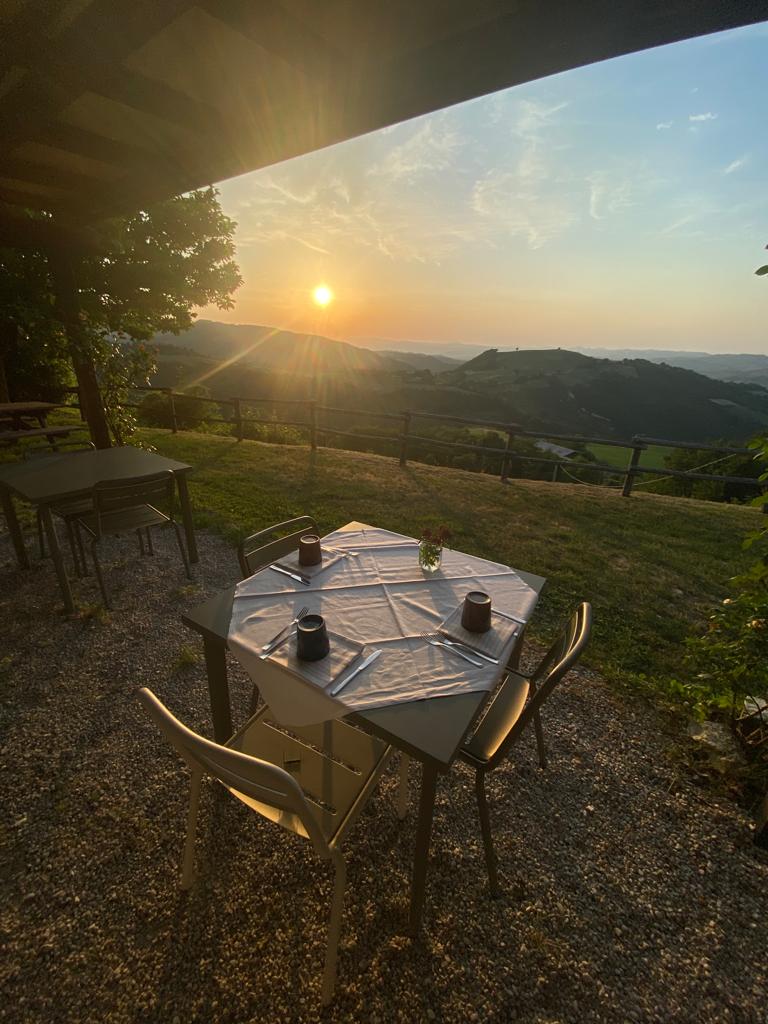
What he said is partly true (except for the “teleporting” fantasy). But Italy is also its geography, as far as I’ve seen. You can see the effect of geography in the cities along rivers, Florence and Rome, and between the mountains in the industrial north.
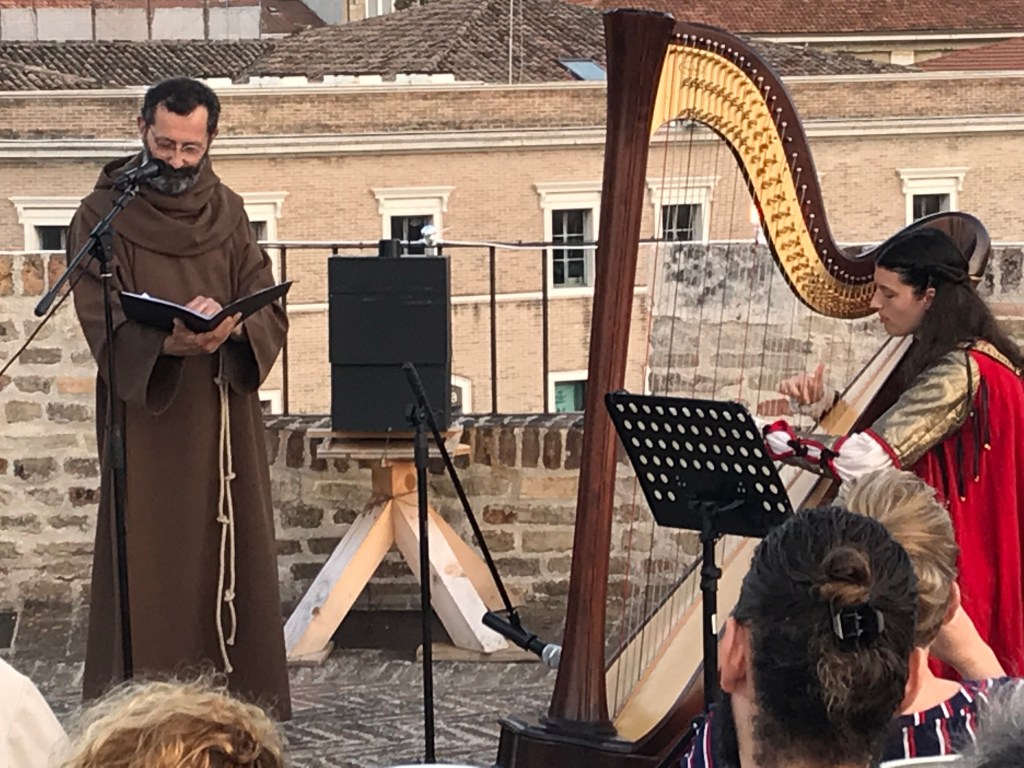
I have been most beguiled, though, by the way Italians live in and love the beauty of so many smaller cities in the central hills and coastlands. You’ve probably never heard of these cities of the Marche province. Sassocorvaro, a good place for weddings as the city of love. Recanati, where the poet Giocomo Leopardi was from. Urbania, where the streets resonate with singing from open windows of its opera schools. Senigallia, an Adriatic town where we wandered onto a castle rooftop and found a man in a monk’s robe reciting Dante while a costumed woman played a harp.
Tomorrow, I will finish these daily posts with something I wrote visiting a magical hilltop city in Umbria called Treve. Thank you for reading and for subscribing. Hold on. I will revive this when we get to Italy. I hope to have you as readers then. You may be getting some updates before that.
Ciao. A piu tardi.

 An American journalist heads for Italy to see his country changing from afar.
Leave a comment