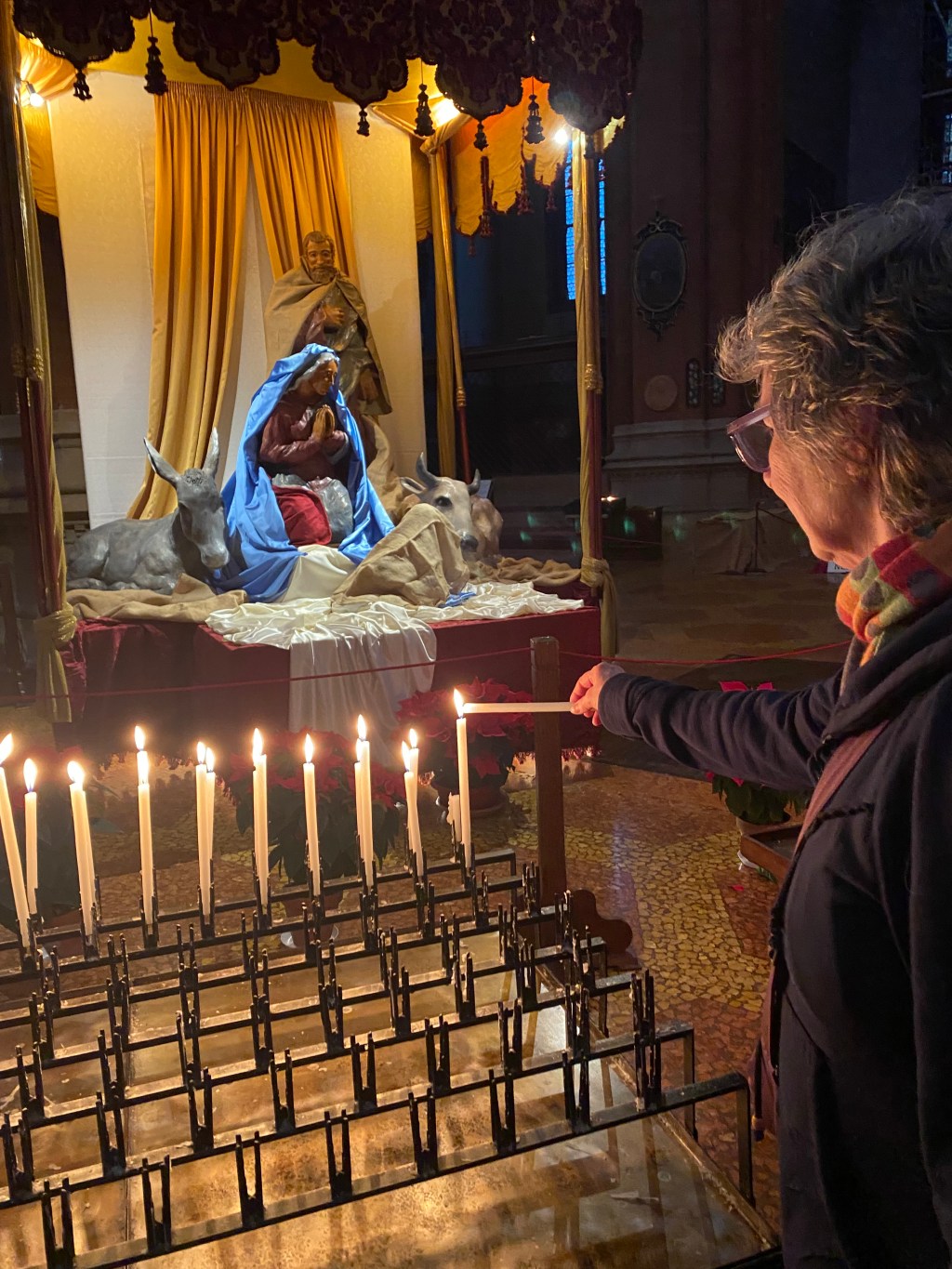
Huge old echo-y churches are all around. In the historic districts in the heart of Italian cities, where cars are virtually banned, you walk into dim sanctuaries that hold you in a silent awe. There’s some kind of awesome mystery here.
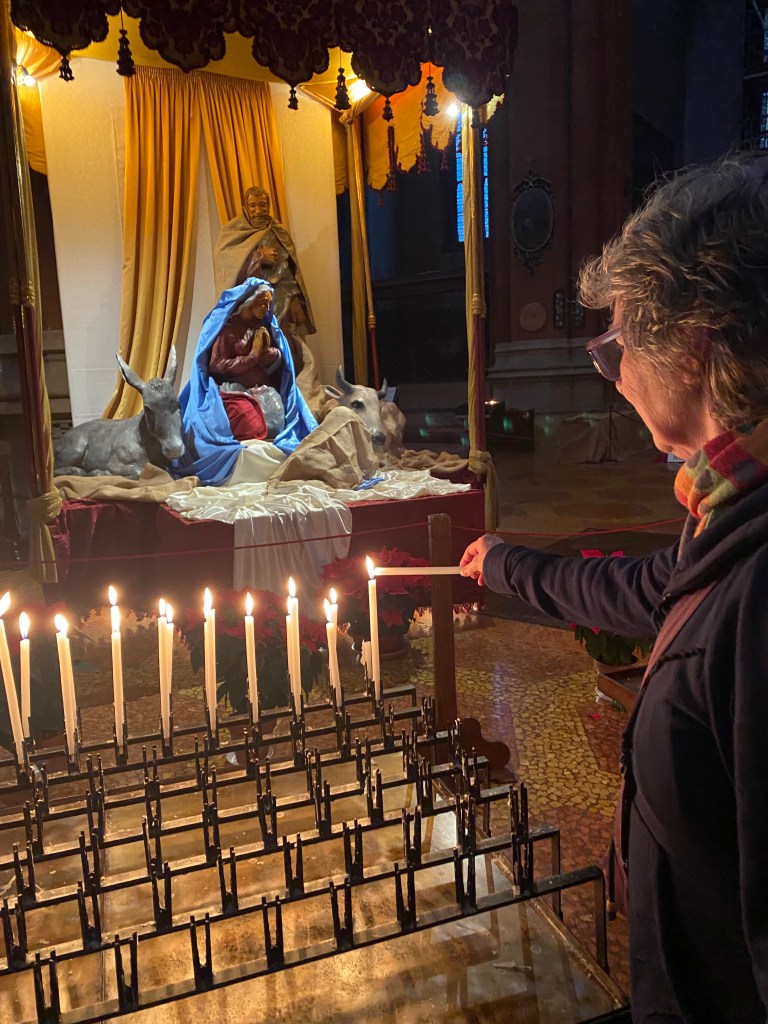
It’s Advent, so a Nativity scene of the Holy Family sits under a lit canopy in the Basilica of San Petronius in the heart of Bologna. Libby lights a half-euro candle there, a practice she’s adopted for our daughter’s passing two years ago. I wander to the other side, crossing unaware a meridian line that a 17th century astronomer made on the marble floor to trace the path of a ball of light from the noontime sun. But it’s dark now, a late December afternoon.
I look up at a looming Bishop Petronius, who has a great beard. The church is named for this fifth century figure who became the patron saint of Bologna in the 12th century. By then, he was all bone relics and legend, not much historical documentation. In the Renaissance, he was portrayed as the city’s guardian, holding in his hands a model of the city within brick walls, with some of the buildings and crooked twin towers you can see today.
Michelangelo lived in Bologna twice, briefly – once as a young art student and next fallen out of favor, then in favor, with Pope Julius II. His second stay is well documented by letters he wrote from Bologna to his brother. These letters are on display in the exhibit we saw, Michelangelo e Bologna, in the Palazzo Fava. Also, the sculpture of San Petronius started by one of Michelangelo’s influences, Jacopo della Querca.
Michaelangelo finished that sculpture, using techniques he would use for his David and the tomb of Julius II.

The art of the Renaissance at its height, in Michaelangelo’s time, is associated with Humanism, a philosophy broadly credited with elevating the human person as worthy of as much attention as God.
This being the Christmas season, with little church and commercial lights shining in darkness, we attended the sweet Mass yesterday morning, Sunday, in the relatively small medieval Cathedral next door to our Airbnb in Fano, Italy.
The gospel reading and sermon (in Italian, of course, which I almost understood) were about Joseph’s dream (sogna), an angel telling him to take the pregnant Mary as his wife. The Gospel of Matthew (Vangelo Secondo Matteo) says this was to fulfill a prophesy in Isaiah that “la vergine concepirà a patorirà un Figlio, che chiamerà Emmanuele.”
Veni Emmanuele was the concert later that night in the little Cathedral. (We enjoyed another Christmas concert, the Fano community band with incredible jazz trombone playing by someone named Massimo Morganti.)
Emmanuel means “God with Us,” and this “con noi” was the theme of the Mass we attended. It struck me, gradually, that this is a much fuller understanding of Humanism. It holds that the mysterious One of the cosmos is “with us” human beings – specifically in our human nature, our humanity. Can you name any other thing in the universe like us? (It’s popular today to say, yeah, we’re the problem. Or to say we’re just another species of animal, homo sapiens. But Italy gives us another perspective.)
“More than any other country in the Western world, Italy may be said to have been humanized.” That’s from a University of Virginia art professor, Frederick Hart, in his book The History of Italian Renaissance Art.
In the dark mysterium of the medieval churches here, and in the warm communities of people, this is something to think about. The cities have been humanized (reclaimed from traffic), full of people arm-in-arm, talking, pushing babies in carriages. The people are humanized in families and communities in ways that American families are not, so much.
Something to think about with the rise of inhuman Artificial Intelligence, which takes only the data-processing part of our human-ness and leaves us infinitely behind in that dimension. Something to think about in the Christmas spirit.
Buon Natale, tutti!

 An American journalist heads for Italy to see his country changing from afar.
Leave a comment