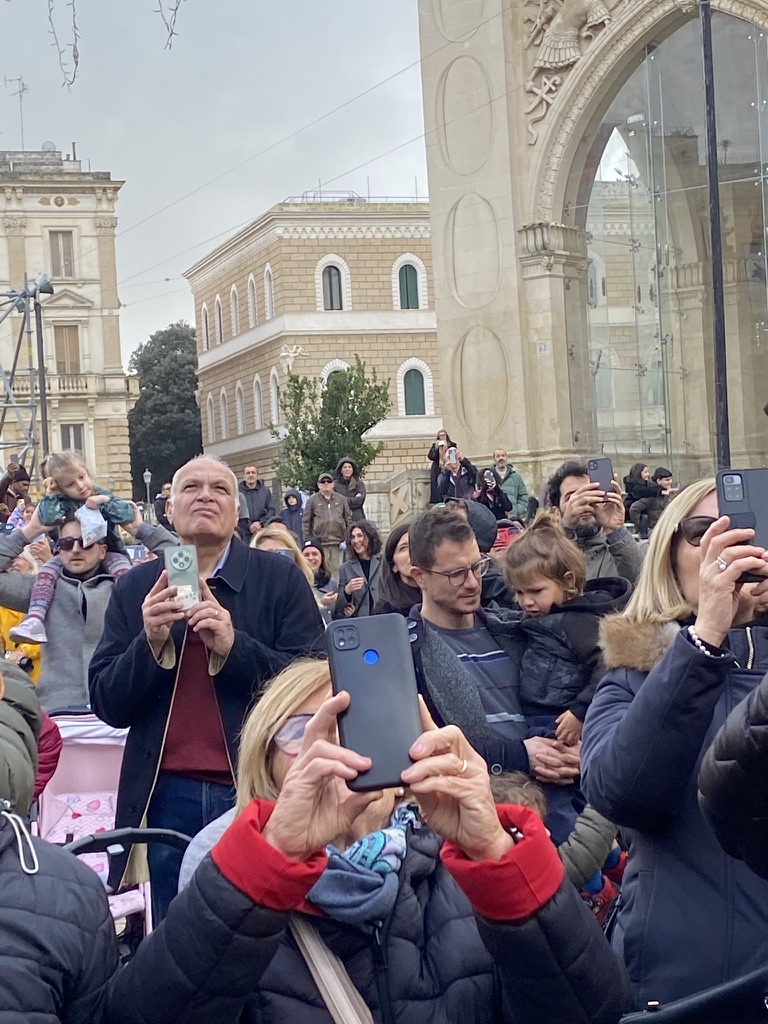
The language we learn from infancy to childhood, from classrooms to books, becomes the water we swim in.
That’s a good metaphor. We swim in our language, not caring how it keeps us afloat. Like fish, we don’t need to think about the water. But like humans, we CAN think about it. And, wow, what a complicated thing it is.
We name things with nouns, but what’s the relationship of a word like “flag” in our mouth, or in an email, to the thing (that flag, or any flag)? Where is the relationship in our brains, or in the other person who is listening or reading? Worse than just naming, we use grammatical structures that allow me to use a comma, like this, which is a form of punctuation, which I am over-using now, and I could go on and on, like some people do, you know? and you could follow me. But why would you? Linguist call that “recursion,” and they have no idea where it comes from.
I am trying to learn Italian like someone trying to learn to swim by putting a toe in the water. I love the idea of Italian. It’s exciting. Familiar words from music notation (con brio, crescendo) and my high school Latin (O tempora! O mores!) draw me in. I love the sound, the rolled “r”s. I am as soothed by listening to Italian poetry like this, “The Winter Sun,” or Leopardi’s “Night Song of a Traveling Shepherd” as I am listening to Bach or the Beatles.
I have put my toe in the water of l’italiano many times, from various teachers and books, as if from baby pools to the Adriatic (literally!). But something holds me back. Maybe I am scared, ready to panic, as I was when I first learned to swim. I love the language, but from the safety of the dock.
On April 14, I will be in Italy again, for two months this time. Maybe, by the end, I’ll be dog-paddling, if only in the shallow end.
My latest teacher has been an online charmer in tight shirts and buzzcuts named Manu Venditti. He drew me into “Italy Made Easy,” his vast program of videos and forums, with a free 30-day series on YouTube. I found it encouraging. His pitch makes these three main points:
- Italian is a patterned and phonetic language that can be mastered with a few hundred hours of effort (stay upbeat);
- most other Italian language programs put you on the wrong path, either with memorizing common phrases or teaching grammar and vocabulary. Manu does both, and more, providing variety and a friend you can see (Manu himself)
- and you need constant immersion, playing Italian for hours around the house, even if you don’t understand it (get in the water, boy!).
Venditti is very Italian, but staying in the United States as a teenager made him want to understand other languages and cultures. He learned English and other Romance languages. When the videos were made, he was learning Japanese and living in Australia.
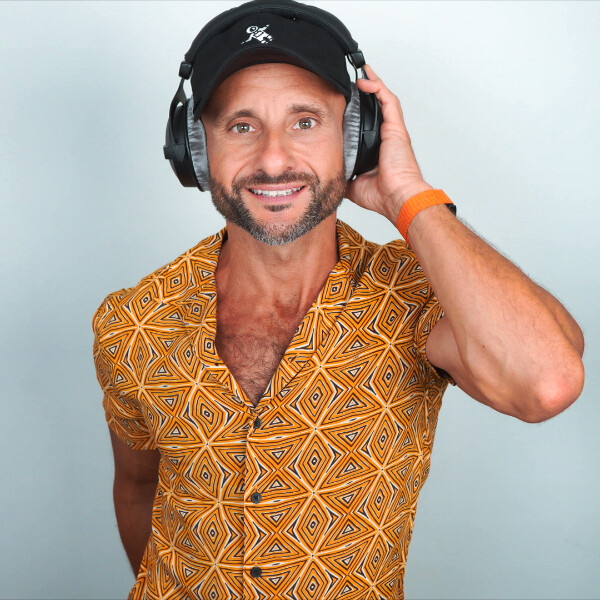
Every lesson (once I was hooked and paying $80 a month) feels like an expansion of my Italian knowledge and skills. I can show off a little knowing how Italian works with only 21 letters, and only seven “forward” vowel sounds (compared to 21 in English, mostly back in the throat and not as “pure”). How the letters are used is very logical, consistent and efficient. (There are no spelling bees in Italy.) A “k” sound is made with “c” followed by “h.” A “j” sound with “g” followed “e” or “i” (silent if “a,” “o” or “u” come next, e.g. Giovanni).
He says Italians have many dialects that come from the different languages spoken before Italy was unified (a mere 165 years ago). Then it adopted the Italian of the educated elite. So most Italians speak Italian with a “foreign accent,” because it is like a second language.
That makes me feel better, which is one of Venditti’s goals – to make us all feel good and confident that we can do this. Just jump in.

 An American journalist heads for Italy to see his country changing from afar.
Leave a comment