Walking from town to town would be very different if this were Kansas, or Tennessee.
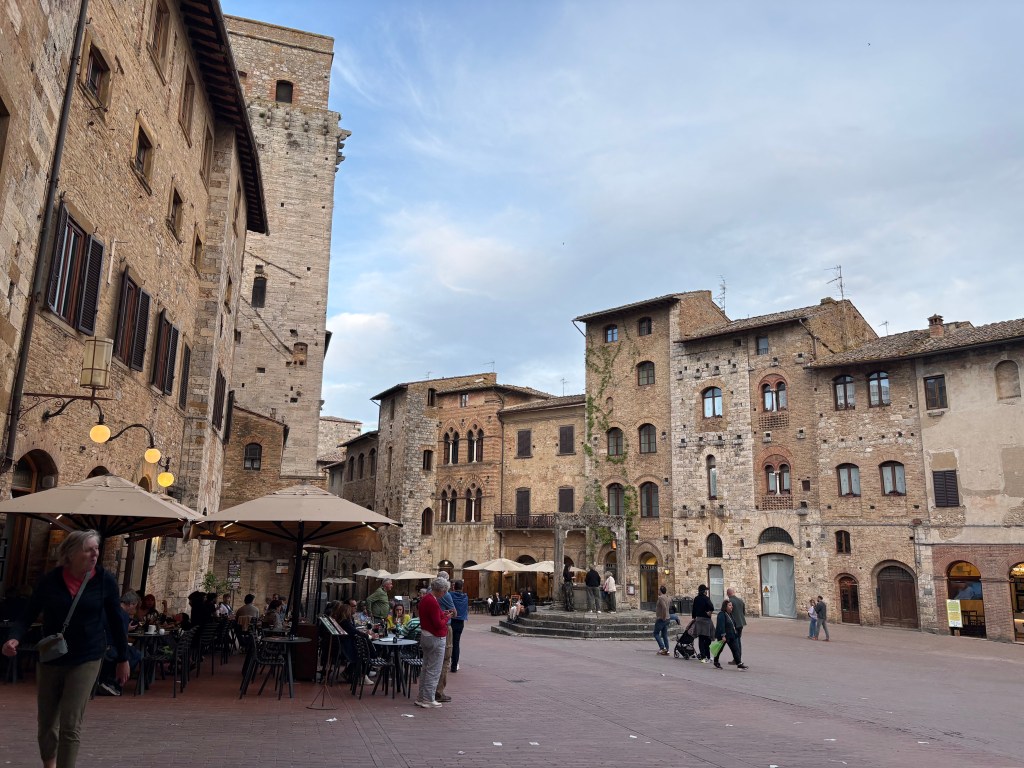
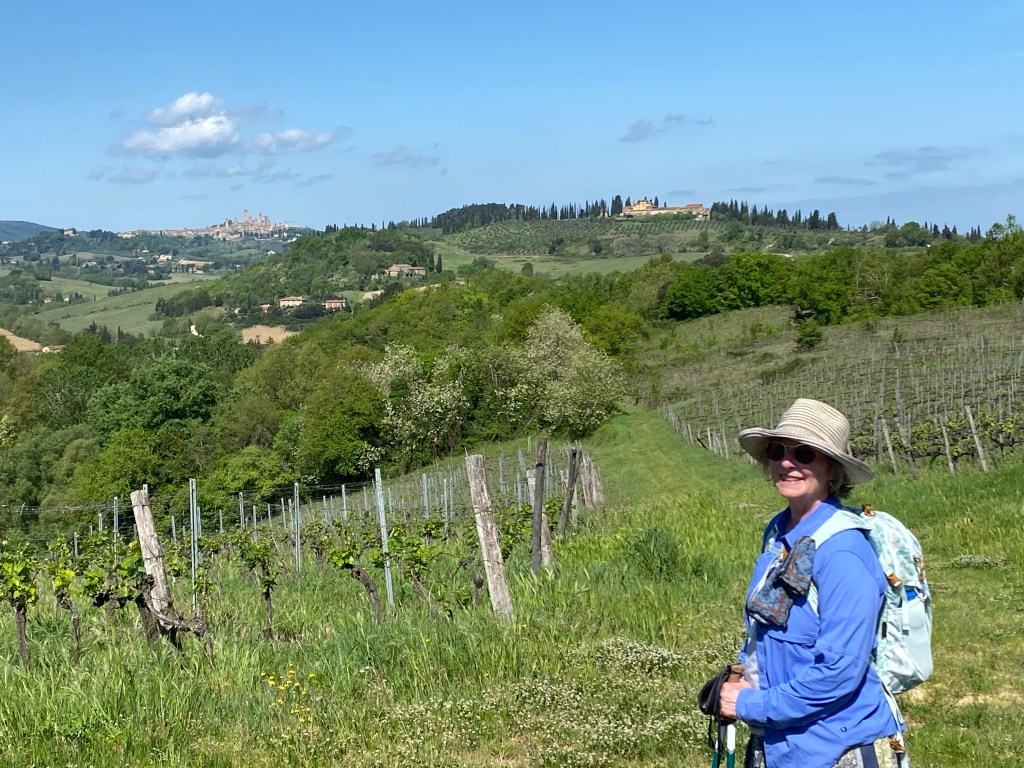
It’s Tuscany, and we’re on the antique Via Francigena (or occasionally off it, mixing up the varied trail markings with the Google maps of our spotty iPhone service).
“FrrranCHEEgehna,” the local laborer corrected our pronunciation when we thought we were lost beside one of the orderly vineyards we passed.
We left San Gimiagno Monday morning, walking down the steep hill between two groups of other pilgrims who seemed to appreciate us as exotics – married Americans. The previous afternoon, a sunny Sunday, the town had been crowded with Italians and the scent of leather and linen from the shops. An actor dressed as Dante recited the Divine Comedy with fury in the main piazza. The line at the most popular gelato store was long. The town has so many medieval towers, it’s called Little Manhattan for its skyline from a distance.
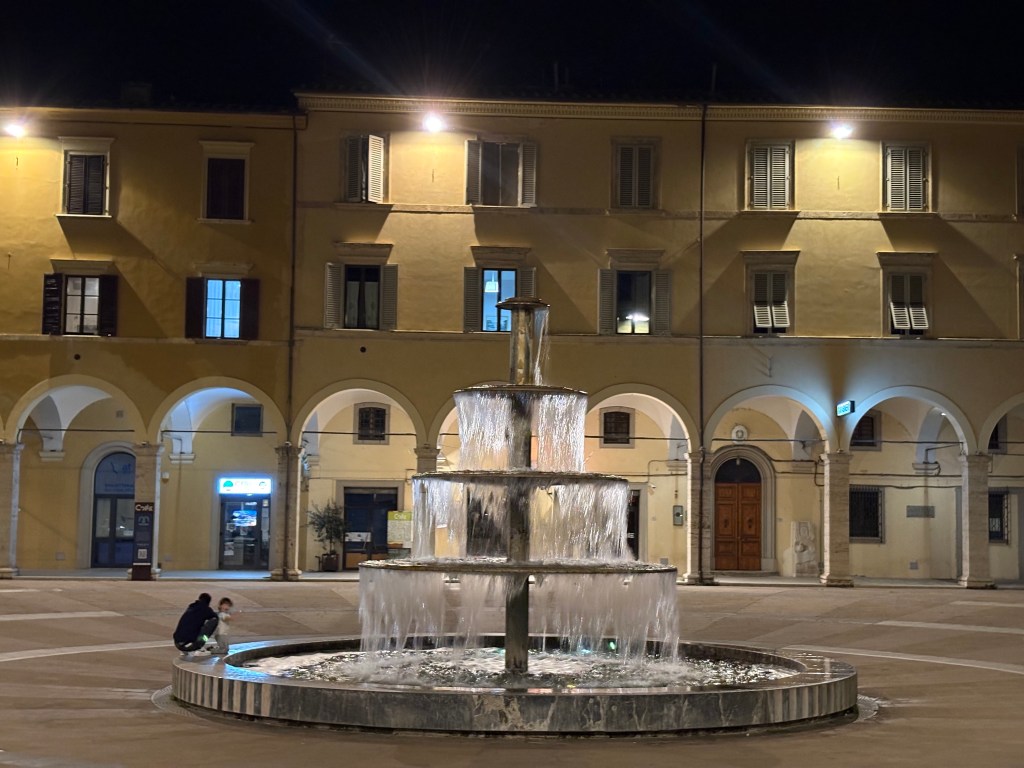
Colle di Val d’Elsa (“Hill of the Elsa River Valley”) was next. Much different atmosphere, slow-moving locals of all ages, not many hanging out in the central piazza with its 1925 monument to WWI dead and a layered fountain spilling over furiously. After our 13 km walk, we still had enough energy to walk up a steep brick street to the much higher old town, the 11th century “Colle alta” (upper Hill).
Unique and layered, this lofty stone town-within-a-town amazed us. Still, we kept finding elements here and in other towns that reminded us of an Italian town far on the other side of the Apennine Mountains that run down the middle of Italy like a spinal cord – Urbino. I was on the faculty of a month-long American multi-media program in Urbino five times since 2011. We got to know that Renaissance city well.
We know Italy was divided into many warring regions, isolated walled cities, dukedoms and Papal States, for centuries. It was not unified as a country until 1861 (the very year America divided into two, the Southern half attempting to slide backward into its almost Sicilian signorial culture). Even Italian dialects were divided until then, when the Italian of the educated elite was adopted from boot toe to the Alps.
Still, in any historic city center, we recognize unchanging motifs of architecture, landscaping, menus, duomos and chapels, Catholic shrines, enjoyment of life, mausoleums, flowering-vine arbors. How did such a unified culture come about over the centuries, and hold on?
I don’t know. We can’t walk across the American landscape like Forrest Gump and ask why a very different American unity has fallen to pieces.
I do see one difference among Italian cities in this middle belt. The ones on hilltops tend to be walled in medieval and Renaissance-era defense. The ones on the coast or in river valleys tend to be older, established along with Roman roads or ships, their safety guarded by the Empire and Pax Romana.


Leave a Reply