
To prepare for walking the old Tuscan footpath of European pilgrims and Crusaders, I borrowed a 1919 book by an idealistic American walker who represented the American Red Cross in Palestine 30 years before it became the modern state of Israel. It had finally been liberated by the British after 300 years under the Ottoman Empire.
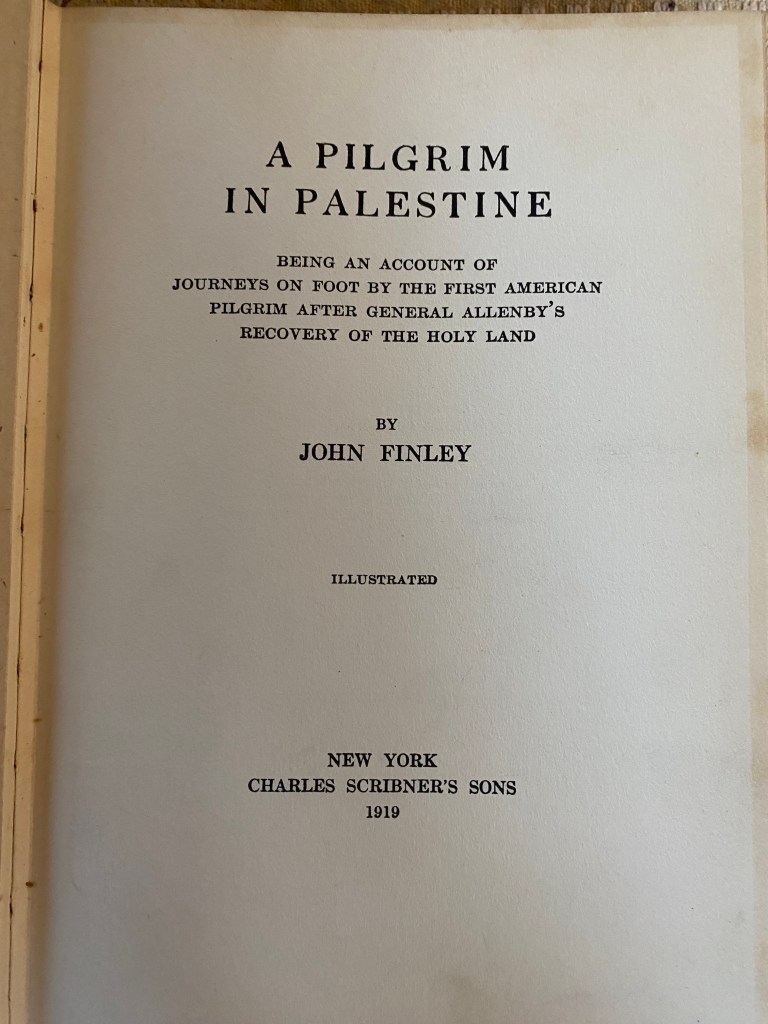
“A Pilgrim in Palestine: Being an Account of Journeys on Foot by the First American Pilgrim after General Allenby’s Recovery of the Holy Land” is by John H. Finley, whose great-granddaughter Lucy loaned me the book. Finley’s annual walks around Manhattan are memorialized by “John Finley Walk” markers along the East River. His walks across New Hampshire, he wrote, were no less challenging than his walks across the similar-size Biblical landscape in 1917, “from Jaffa to Jericho and from Beershiba to Dan.”
John H. Finley is a familiar type to my study of American history. He seems like the very embodiment of what is called the Progressive Era, or what the historian Richard Hofstadter called The Age of Reform, from about 1890 to 1920. In fact, Finley was personal friends with Presidents of that era from Grover Cleveland to Woodrow Wilson.
Finley’s perspective on Palestine reflects the American optimism of the educated elite of that era. He knew the Bible well, and considered it progress for “Christendom to walk again in its holy places free of the Turk.” He also knew the Scottish anthropologist George Adam Smith’s book on Palestine of that period, which acknowledged indigenous Arabs living in the land for centuries. Finley imagined both prophecy and Progress as being mutually supportive energies, praising General Edmund Allenby’s military discipline but also noting that his name could be rendered in Arabic as “Allah-Nebi,” or God-prophet.
The goal of “A Pilgrim in Palestine” was to “help put upon the horizon of all America this religious homestead of Christian and Jew, of Catholic and Protestant alike; not alone that we may still learn of its ancient and sacred teaching but that we may too bring our glory into it.”

I was reminded of the “glory” of the Progressive Era, my favorite era as a journalist, by reading with dismay how Supreme Court Justice Clarence Thomas blasted that movement as the ultimate betrayal of the “Declaration of Independence.”
He blamed Progressives for being enamored of Europe. “Progressivism was not native to America,” Thomas said in a lecture last week at the University of Texas Law School. Progressive reforms (e.g. voting rights for women, the Federal Trade Commission, the Federal Reserve, etc.) came from the strong-state and “scientific” ideas of Bismark’s Germany. Thomas said this betrayed the Founder’s ideal of all men created equal, and their pledge to honor that ideal.
A couple of commentators called Thomas’s interpretation of the Progressive Era nonsense and historically illiterate. “American progressivism emerged organically from social movements that targeted the ills of late-nineteenth-century American life,” wrote one commentator in The New Republic, a magazine founded in 1914 by some of the movement’s leading lights. “Good-government activists like Robert LaFollette and Lincoln Steffens exposed local corruption and promoted the secret ballot and primary elections. Ida Tarbell, William Hard, and other muckrakers exposed the oligarchical abuses of monopolies like Standard Oil and U.S. Steel. Trustbusters ranged from Louis Brandeis and William Jennings Bryan to William Howard Taft.”
It’s true that many of the intellectuals of the era brought ideas of “scientific” sociology and the modern research university from Heidelberg (e.g. Lincoln Steffens, W.E.B. DuBois and the model for Johns Hopkins University). But these ideas fed a very American spirit of democratic reform, much of it spread through a higher level of journalism found in new magazines like S.S. McClure’s.

(Finley’s descendants may find it interesting that his wife’s relative, Albert A. Boyden, was another thoroughgoing embodiment of the Progressive Era. His obituary in the New York Times of May 3, 1925, says he was “formerly managing editor of McClure’s Magazine and the American Magazine, later American Commissioner of the Red Cross Societies in Poland and widely known for his humanitarian labors.”)
Being in Italy now, I can’t help feeling that my native land could again use some lessons from Europe about facing political dangers with wisdom and sticking together across national boundaries. Likewise, Europe could learn something from the optimism that used to bring America’s best and brightest to “foreign lands” with a missionary zeal for progress in democratic ideals.


Leave a Reply