A retired AP correspondent, Douglas Grant Mine, wrote a feature story on the discovery of the Vitruvius basilican in Fano. He released it on his newsletter three weeks after I left Fano having failed to write something very much like this story. I knew the dramatic elements were sitting there, waiting to be written. But I lacked his advantages — he lived in Fano with his Italian wife and spoke fluent Italian. Here is his excellent feature story. And here is mine.
When the city of Fano wanted to restore the Piazza Costa in the middle of the old city, it invitefd a team of engineers and archeologists to check underneath the cobblestones.
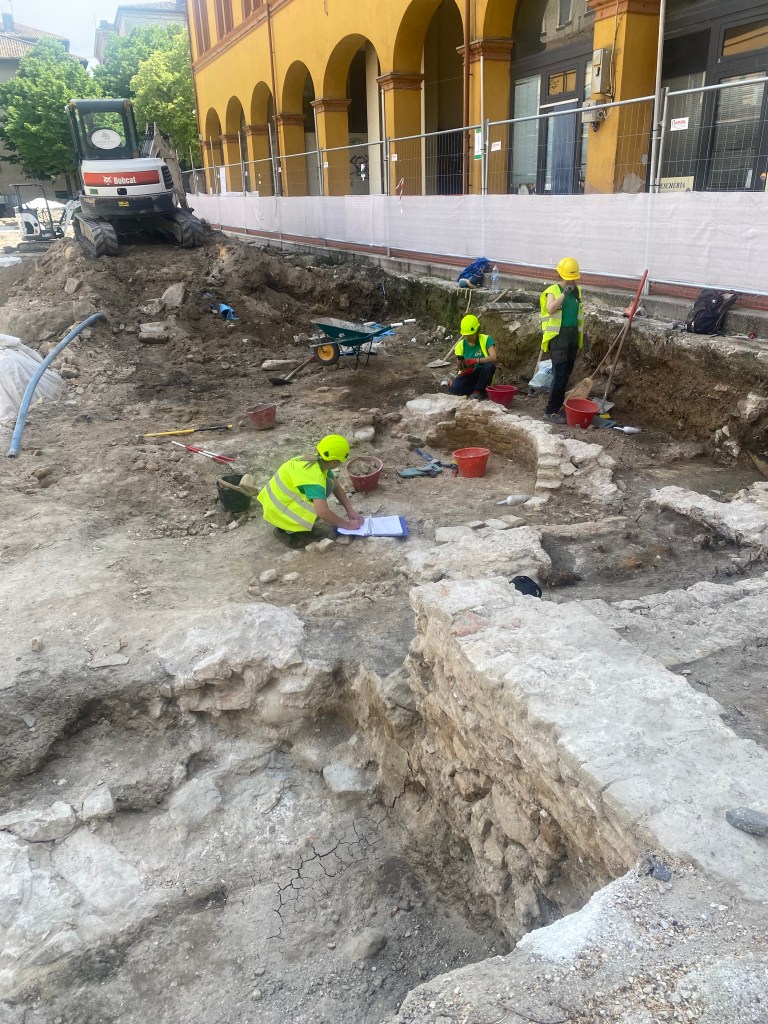
This is a common requirement in any old city in Italy where new construction is planned.
But unlike other ancient cities like this, Fano had a special mystery under its surface, sought for 2000 years.
Scholars knew about this mystery, down to the exact measurements, because it is described and drawn with an engineer’s precision in a book that was written on 10 Roman scrolls called De Architectura.
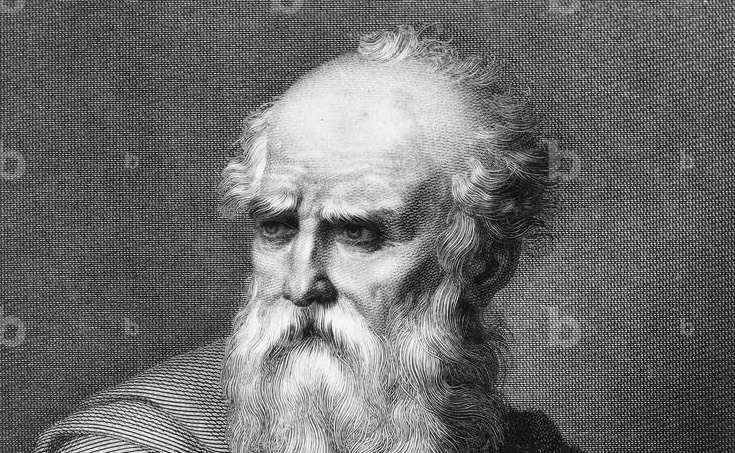
The book had enormous importance because the author, Marco Vitruvio Pollione, known as “Vitruvius,” became the sole authority of architecture in Europe long after his death around 20 A.D., from the Early Middle Ages through the Renaissance. Even today, his three key principles of building design — Firmitas (strength), Utilitas (function), and Venustas (beauty) – are taught in architecture schools.
One reason for Vitruvius’s authority is because he survives as a maestro of the Augustan age. His book articulates the theory and engineering behind those long-lasting Roman constructions, although it’s not clear how much he influenced them directly. He described with blue-print precision the engineering of aqueducts, bridges, temples and forums.
The other reason he is important is that his De Architectura alone survived the Dark Ages. During those blank centuries, Christian monks (see “How the Irish Saved Civilization” and my previous blog post) copied what texts they could save, and the only one on architecture was this one. Its designs became the basis for Romanesque and Gothic churches and classical civic buildings for 500 years. Renaissance architects from Andrea Palladio to Leonardo Da Vinci bowed to Vitruvius.
He wrote The Book. But he didn’t build much. In fact, the only known building by Vitruvius is one he proudly describes in Chapter 5 of his book. “But the basilicas of the greatest dignity and beauty may also be constructed in the style of that one which I erected, and the building of which I superintended at Fano,” he wrote (Morris Hicky Morgan translation, Harvard U. Press, 1926, with Vitruvius’s illustrations).
“Its proportions and symmetrical relations were established as follows. . .” and here he goes into details of measurements and placement.
Vitruvius was born in Fano, joined Julius Caesar’s army, and eventually became a military engineer. This basilica was his gift to his hometown and to the first emperor, Augustus Caesar.
So beginning last October, engineers from the Polytechnical University in Ancona, the university covering Fano, and archeologists from the University of Urbino, an hour away, studied the findings of the dig under Piazza Costa. What they found was a jackpot win.
The ruins of the columns and walls matched the Vitruvius basilica exactly.
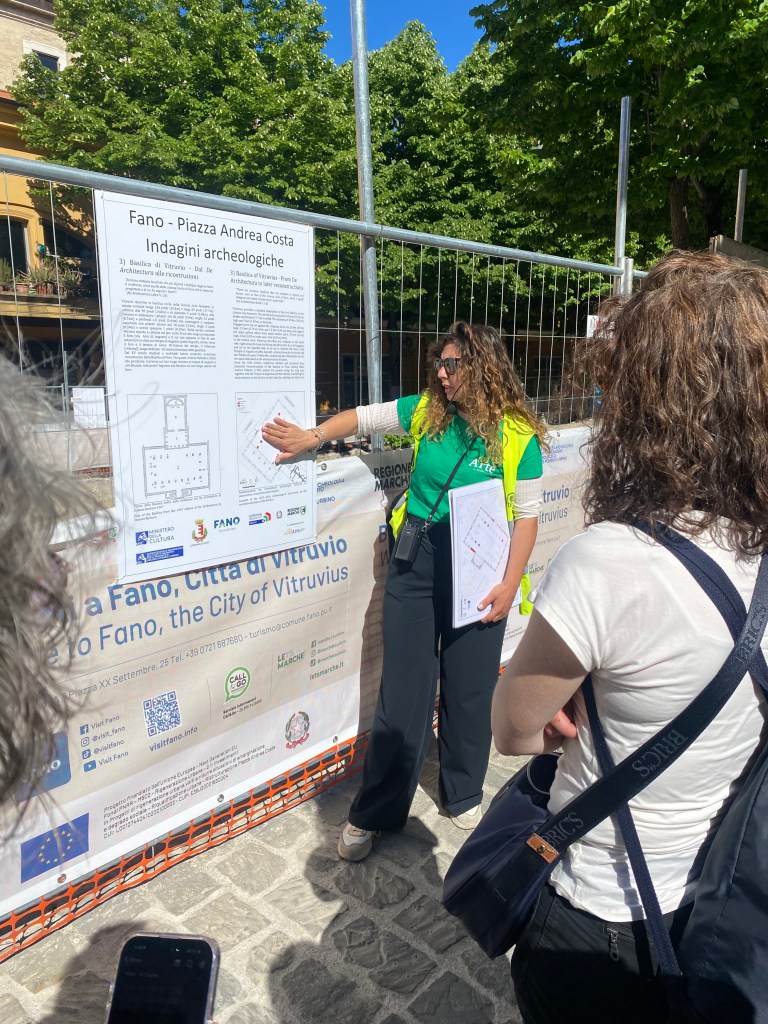
One distinguishing feature of that basilica is that its colonnades used single tall columns from base to roof, supporting a second-story floor, rather than the usual two columns divided by a second-story floor. Vitruvius solved the problem of supporting the second-story floor with an original idea – a brick pilaster connected to the side of the massive 1.5-meter-wide columns.
The investigators found a section of a pilaster with each of the columns they uncovered. The discovery was announced by Italy’s minister of culture in Fano on Jan. 19, written up in Smithsonian Magazine, and covered in Italy as “the discovery of the century.” It was compared to Howard Carter’s discovery of King Tut’s tomb a century ago.
“There is absolutely no doubt,” said (through an interpreter) Piergiorgio Budassi, a retired math teacher in Fano who lectures on the discovery. He and other tour guides need to keep up with new discoveries almost daily as they speak to the growing number of Vitruvian tourists.
Tomorrow: Fano’s vision of the future as the city of Vitruvius’s basilica.


Leave a Reply