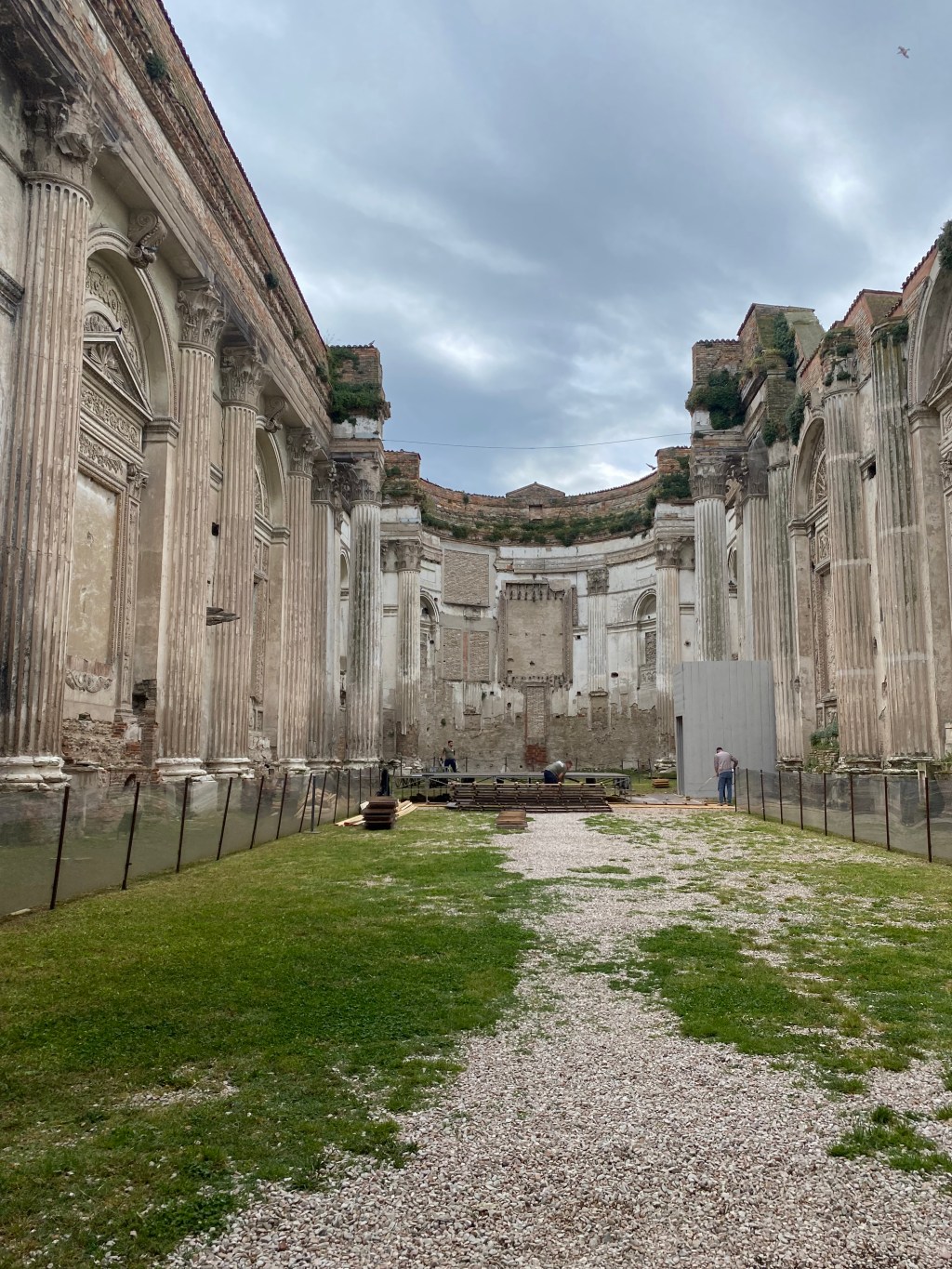
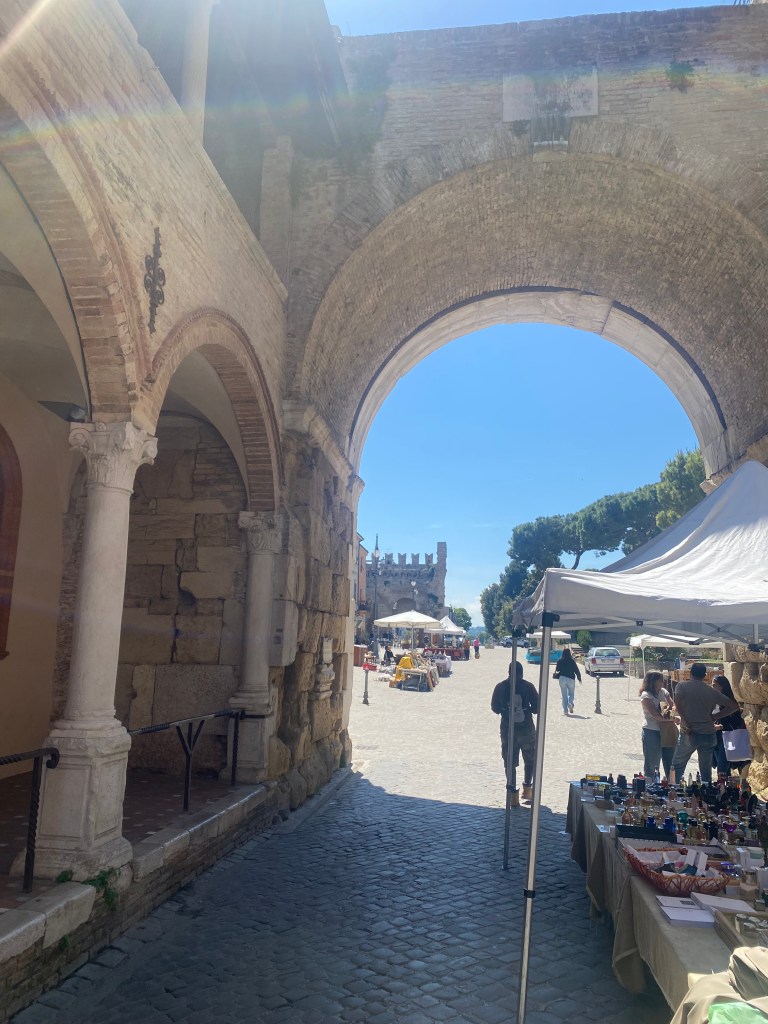
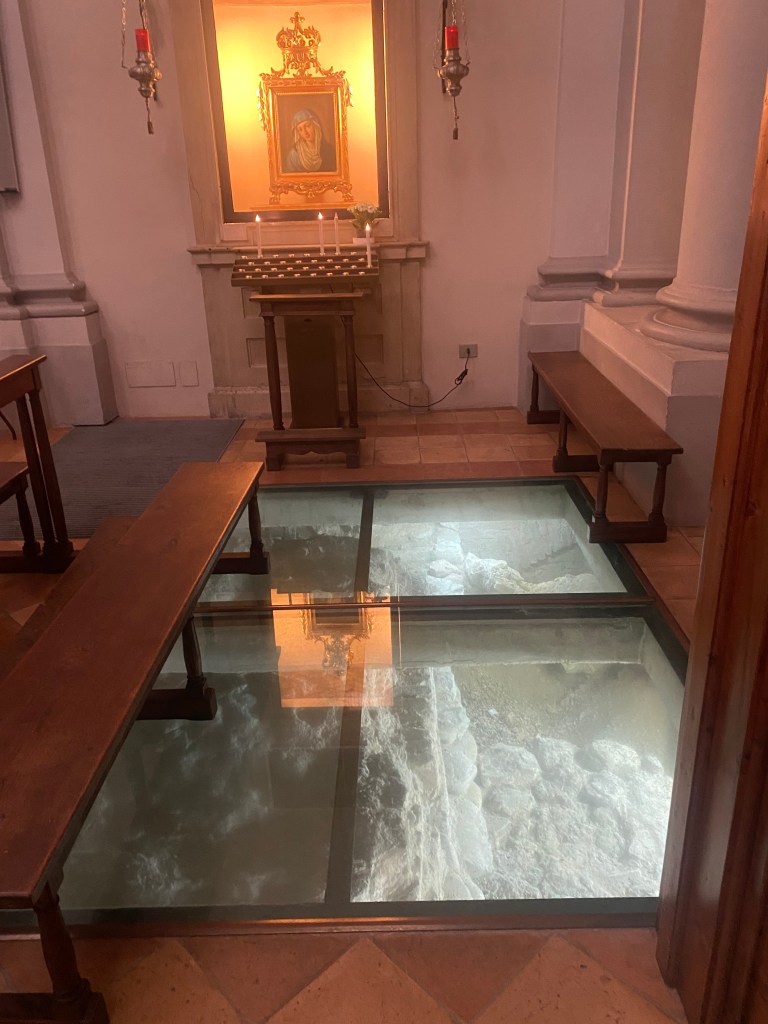
In a magnificent niche of the medieval Fano wall, a thick Plexiglas sheet offers a double vision. Looking through it, you see brick steps descending below the cobblestones into some ancient space, with sprouts of weeds in the mortar. This is in the section of wall with Ghibelline battlements on top. It was the entrance of the city 100 meters outside the Roman entrance, called the Arch of Augustus. A thousand years of human time is folded into that 100 meters between city gates.
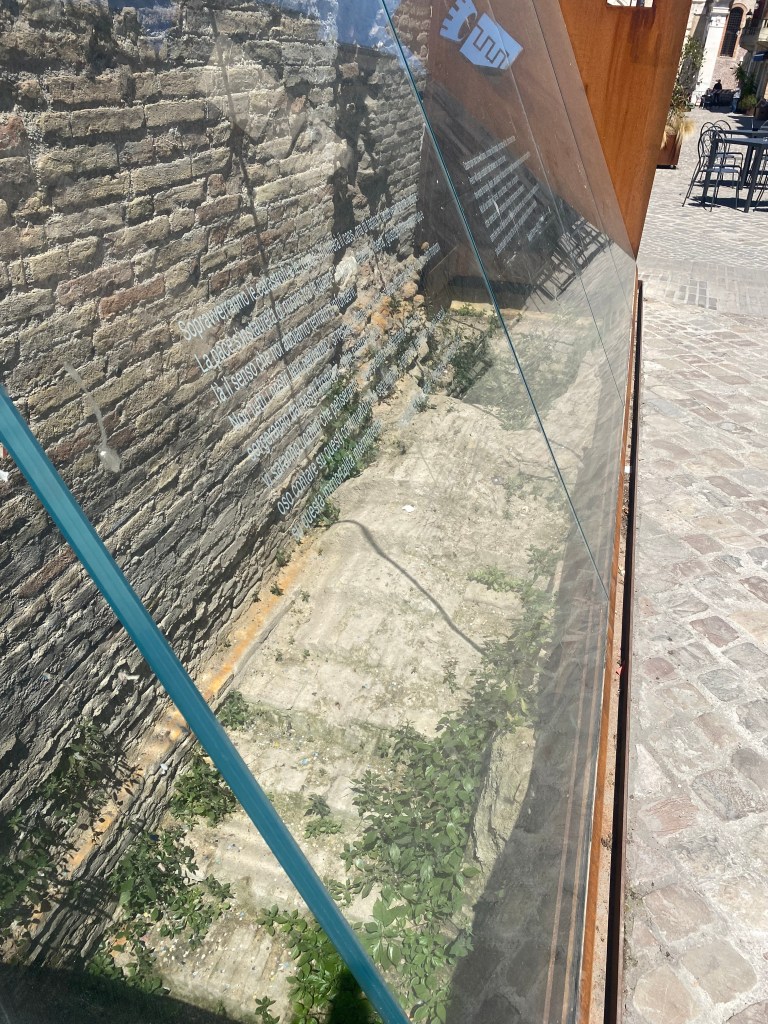
Looking at the Plexiglas surface, you faintly see in white type the Italian and English words of Marguerite Yourcena, from “Memories of Hadrian,” dated 1951.
That’s the year I was born. The words are arranged like a poem, and beautiful enough to be poetry.
But when I look it up, it turns out that Marguerite Yourcene was a French novelist, and these words are apparently from her novel Mémoires d’Hadrien.
In English, the words hit me as a rich meditation on the archeology and culture we are seeing here, and on Trump’s America today.
Catastrophe and ruin will come, disorder will triumph, but order will too, from time to time.
Peace will again establish itself between two periods of war,
the words humanity, liberty, and justice will here and there regain the meaning which we have tried to give them.
Not all our books will perish, nor our statues, if broken, be unrepaired,
other domes and other pediments will arise from our domes and pediments,
some few men will think and work and feel as we have done, and venture to count upon such continuators,
placed irregularly throughout the centuries, and upon this kind of intermittent immortality.


Leave a Reply