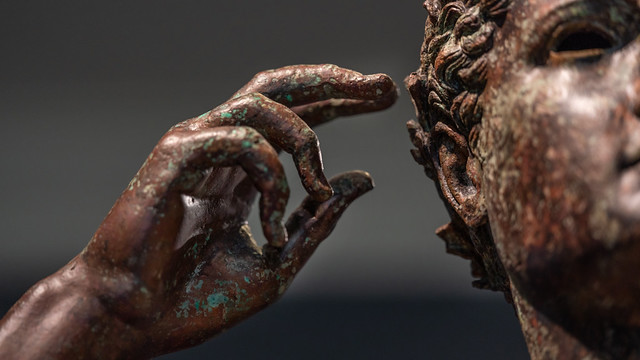
Do you know about the Lisippo statue?
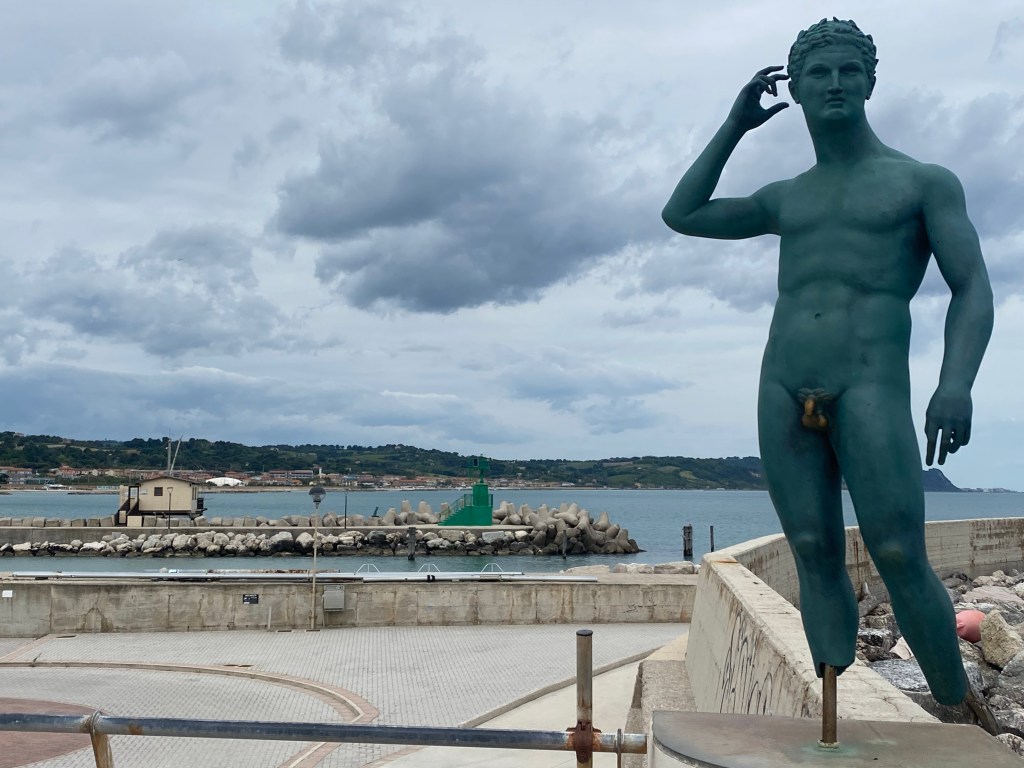
I didn’t.
Luca tried to explain this object of local pride. No, not just local. Italian!
No, bigger than that. European pride.
The Lisippo statue was sold from here for almost nothing, Luca told me. And now it is somewhere in Malibu, California, he said. It would’ve been undiplomatic to say it, but I understood he meant that raw American power, specifically the J. Paul Getty Museum, had virtually stolen this statue.
We were standing, Luca and I, in a very diplomatic setting, a high-ceiling Baroque hallway on the upper floor of Fano City Hall. We needed an interpreter, but lacking that, he did his best to explain to this ignorant American about the Lisippo statue. He said I should walk out the promenade – they call this elevated walkway the “Passeggiata del Lisippo” – to see the bronze reproduction beyond the city’s marina.
But first, I had to do some on-line research.
The statue is also called “Victorious Youth,” presumed to be an outstanding work of one the masters of Classical Greek sculpture in the age of Alexander – Lysippos. It was hauled up in a Fano fishing trawler’s net in 1964, passed through a few hands on the black market for cheap, cleaned by an art collector in Germany, and sold to the Getty Museum in Los Angeles in 1977 for nearly $4 million.
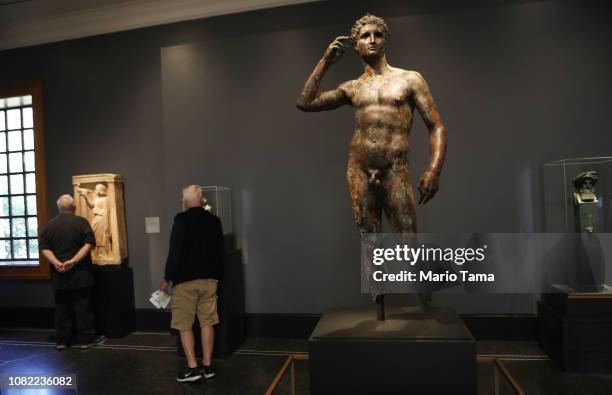
Curators of the Getty Museum and other scholars studied the bronze like a team of world-class surgeons, down to radiological testing, finding microscopic flax used in the original clay mold, and arguing over deep knowledge of classical Greek art.
It was displayed beautifully in the Getty Museum, a realistic Greek ideal of a young Olympic runner wearing only a wreath on his head. Otherwise, he is pure male beauty, except for missing both feet. The original base broke off at some point. A Roman ship, plundering Greek art, apparently sank with the statue more than 2000 years ago.
Fano wanted the statue back, calling it the “Atleta (Athlete) di Fano.” The city sued the Getty Museum in an Italian court, claiming rights to the statue because it was found by a fishing boat from Fano.
The Getty Museum fought back, arguing it was found in international waters and purchased legally. And it was Greek, not Italian.
It didn’t help their case that the Getty Museum had been implicated in a huge scandal in the mid-1990s of illegal art trafficking out of Paris. Several high profile dealers were indicted, including a former Getty curator.
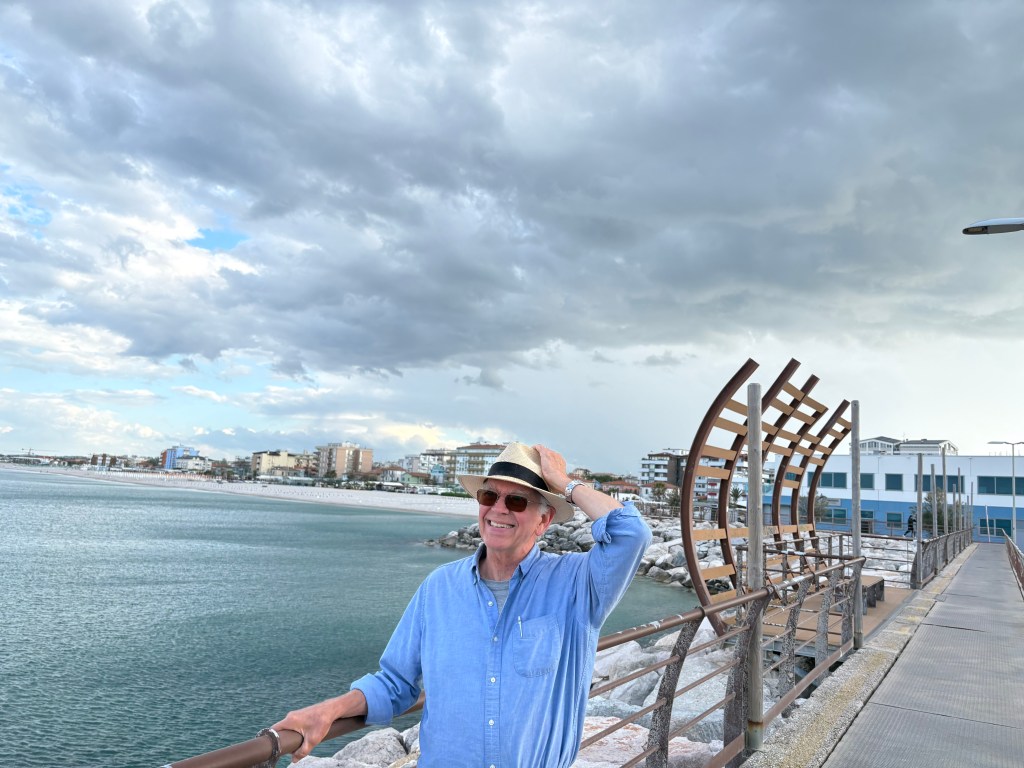
After that, the Getty returned dozens of works to Italy. But not the “Victorious Youth” of Lysippos.
A judge in Pesaro, eight miles up the coast from Fano, ruled against Getty. I wasn’t surprised to learn that. But I was impressed to learn further that on Nov. 30, 2018, the “Supreme Court of Casssation” in Italy denied Getty’s appeal, and on May 2, 2024, the European Court of Human Rights affirmed the ruling of Italy’s Supreme Court of Cassation.
It is not clear where the original statue is now. An online “search assistant” says, as of now, the Getty Museum is in the process of addressing the court’s order to return the Victorious Youth to Italy, and the statue is not in its possession.
Libby and have been out the jetty twice to view the bronze reproduction of Victorious Youth, which was crafted by a local artist and donated by the Fano Lions Club in 2009.
It’s a remarkable walkway. I’ll quote a promotional website to describe it here:
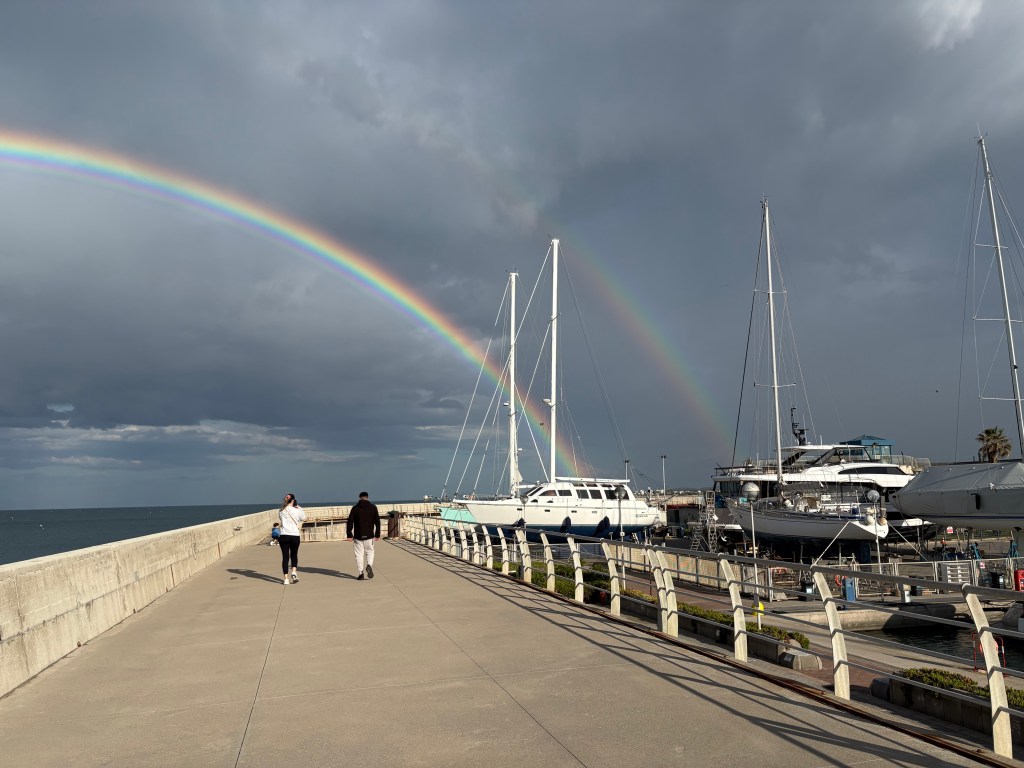
“Stretching gracefully over the breakwater that shelters the Marina dei Cesari in Fano, the Passeggiata del Lisippo unfolds as one of the longest scenic sea promenades along the Adriatic coast. Spanning nearly a kilometre, this elevated pathway invites both pedestrians and cyclists to enjoy tranquil strolls or cycling journeys with stunning sea vistas to one side and the lively marina to the other. The promenade culminates in a striking symbol: a bronze statue . . .”
Not being a museum piece, this version of the Lysippos youth allows touching. A local custom has emerged: Touching the figure’s “equipment” for good luck. We watched one of two women dressed for exercise ahead of us touch his carrot casually before turning to walk back.
So many have sought this good fortune (Fano was once called Fanum Fortunae) that the youth’s jewels have acquired a golden glow against his full-body green.
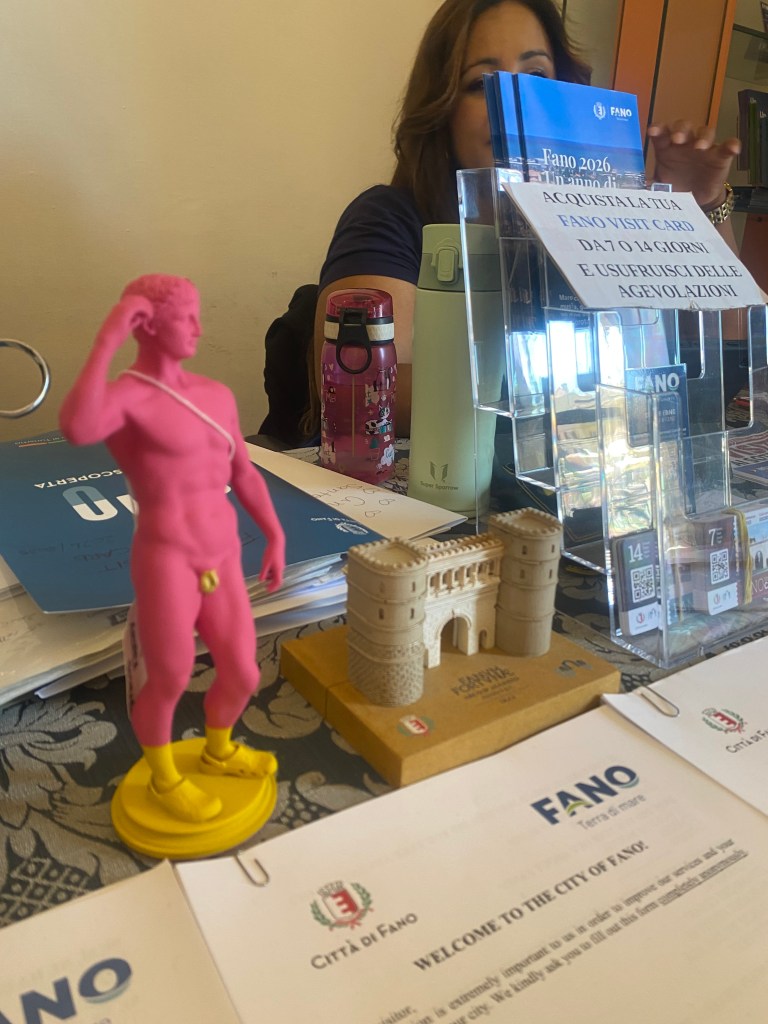
Even a toy of Victorious Youth in the tourist office, fuscia in color, features this feature in yellow for emphasis.
Fano’s proudest antiquity is now something else – the basilica of Vitruvius, the Roman Empire’s “father of architecture,” recently discovered and being excavated in the heart of the old city.
Maybe, Luca told me with a conspiratorial glint, Fano could negotiate with the Getty Museum. Maybe the city could let the museum keep the Lisippo statue if it would help fund the excavation of the Vitruvius site.
Maybe.


Leave a Reply