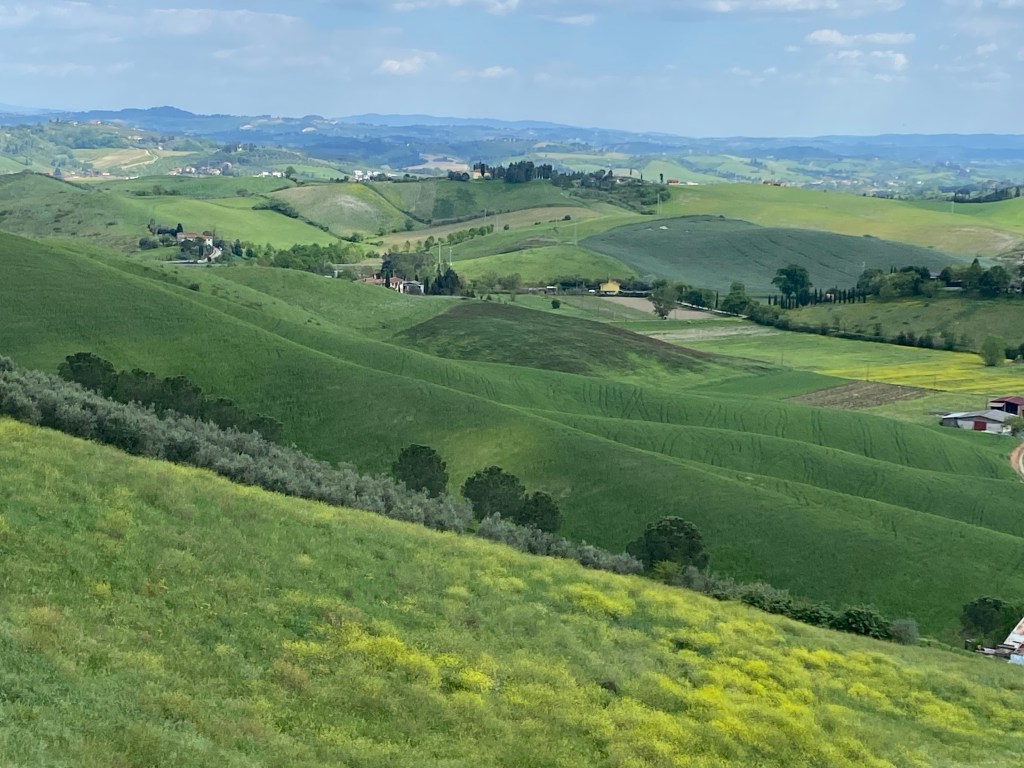
Here is continual spring, and summer in unseasonable months,
the herds breed twice, the trees are good, twice, for fruit.
And raging tigers are absent, and lions’ savage young,
no aconite deceives unlucky foragers,
no scaly serpent slides his huge segments over the ground,
or winds his vast length in coils.
Add to that all the towns, the work of human labour,
built up by hand on the steep cliffs,
and the rivers gliding by the ancient walls.
—Virgil, The Georgics
In this old country of Italy’s middle, we have hiked ancient trails and one-lane country roads. We have walked through woods and between sloping vineyards and olive groves. We have left the walled city, through a residential and commercial mile to sudden quiet. On the basis of nothing but a green space on our Google Map, we found ourselves on long solitary walks with only a few cyclists and Fiats passing by.
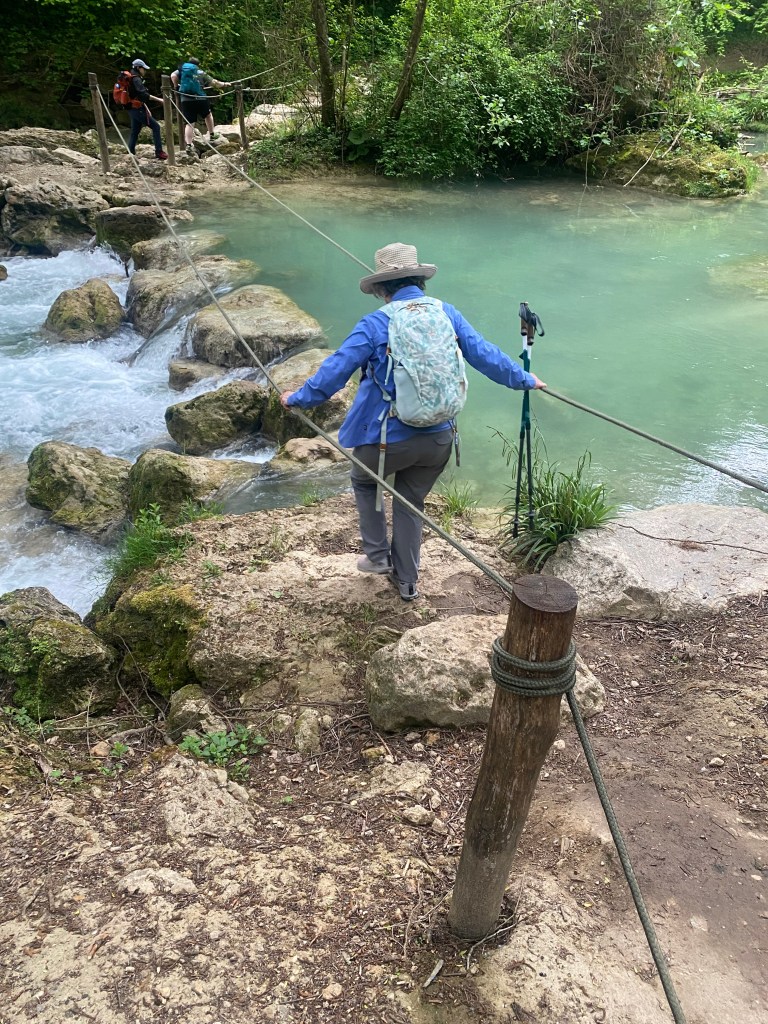
The picaresque is picturesque. We have enjoyed the birdsongs, wildflowers and pastoral vistas, with a prim villa on a hilltop and mountains in the distance.
But something was missing.
In covering more than 100 miles of rural Italy on foot, we have encountered no dangerous or even surprising wildlife, except for one huge jack rabbit and little green lizards.
No snakes, wild boar, bear or other potentially threatening critters that we have seen (or seen evidence of) when hiking in North Georgia. No deer, racoons, ‘possums, coyotes. A few flies and bees, but no mosquitoes, yellow jackets, or wasps (except for the two-wheel kind, called Vespas). No wolves, which we know are protected in Italy and a threat to sheep herds.
Yes, we know all these creatures are out there. Italy is geologically and geographically similar to the Southeast U.S. in that the last Ice Age did not encase it. Flora and fauna are abundant and richly diverse. Its climate is semi-tropical like the South’s, but the Mediterranean and its Italian extensions seem to moderate weather extremes. When we were here in December and January, the cold was constant but not bitter. Since we returned in mid-April, we have had a lot of clear sunny days, and a little rain, but no heat. We almost want it hotter.
Not that nature is Paradise in Italy. But it seems somehow to predate the expulsion of Adam and Eve from Eden. Where we’ve walked, there’s a balance of nature that may be related to Italy’s strong environmental laws, disciplined recycling, public transportation, and clustering of housing and commerce together.
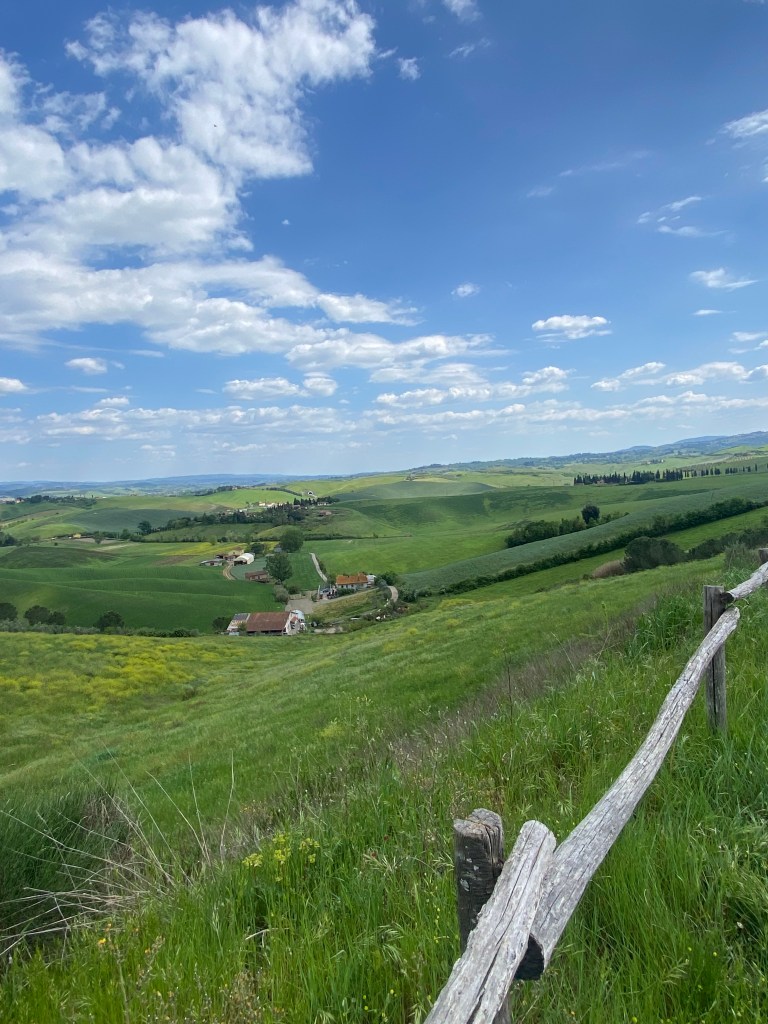
But there’s something else. Italy’s human culture, for more than 2000 years, has treated nature as a source of beauty, like art. Nature here is for human pleasure. Not consumption and not extraction. But pleasure.
Nature is protected, but also tamed, like a garden. National parks in the U.S. are true wilderness – wild-ness. National parks here can be “sublime,” and even “wild,” but it’s more like a literary genre.
This appreciation of human-supervised nature extends into the sea.
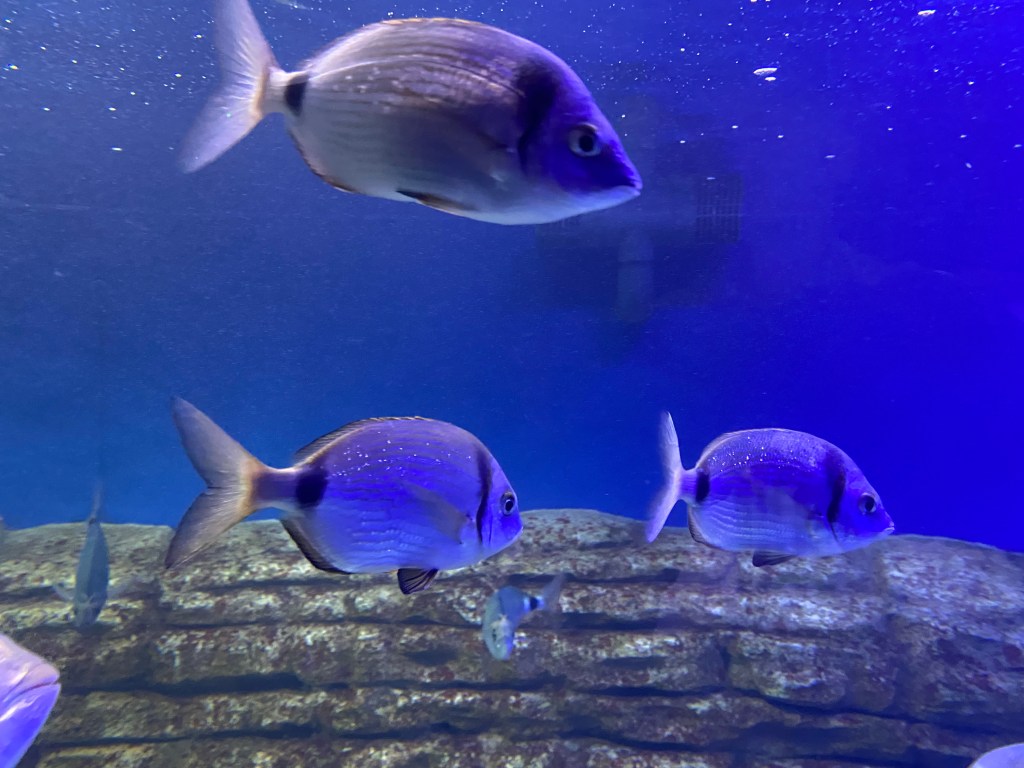
In the Fano Marine Center, a modest well-organized aquarium, the life of the Adriatic is presented as a story.
The narrative begins in a tank replicating the breakwater barriers that protect beaches and harbors in staccato lines along the eastern coast mid-Italy. They are made of concrete blocks or natural boulders, and become home to barnacles, corals, and sponges.
Then comes the soft sandy bottom where sea life is tiny, but fishy enough for the nets called trabocchi dropped from elevated huts. The only steep rock in the Marche coast is at Monte Conero, visible to the south of Fano. The long shallow shelf may be why the Roman Empire came here by the Flaminian Way, not so much by ship.
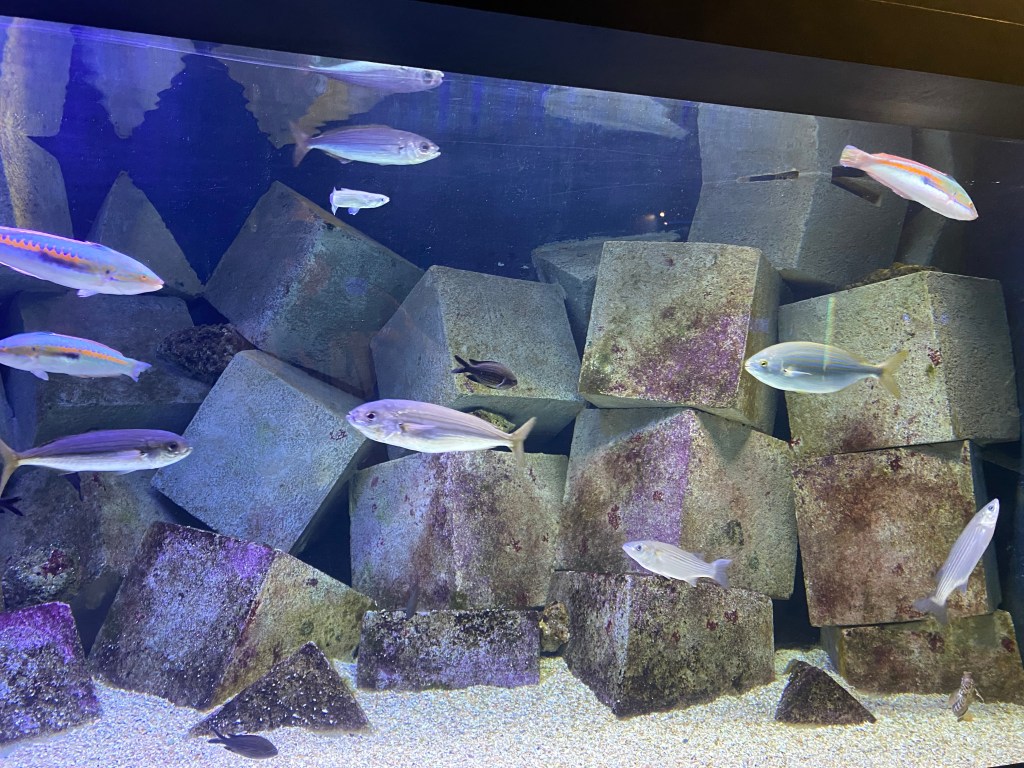
When we visited the Fano Marine Center, behind a crowded elementary school class with a fast-talking guide, we again saw nature as a beautiful wonder that humanity was here to appreciate – and take care of.
The tank describing “alien invasions” stressed the threat to the Mediterranean as a biodiversity hotspot. The Mediterranean “holds the sad record of being one of the richest basins for invasive alien species, with nearly a thousand recorded.” These include jellyfish with more harmful stings than the traditional Italian varieties, and green algae that smother marine life. These are unintentionally introduced by boat ballast or through the Suez Canal.
Climate change is contributing, disturbing the balance by warming the seas. This nurtures tropical invasives and stresses the natives.
Italians are trying to reduce greenhouse gasses with more solar and wind power, and by electrifying transportation. On the sea, they monitor the threats.
We watched a video of a six-meter buoy two miles out in the sea operated by the Life Sciences department of the university in Ancora. “Submerged sensors provide measurements of temperature, salinity and oxygen, as well as other fundamental parameters for monitoring the state of the sea.”
While the Trump Administration is pruning our government’s essential data-keeping (see the dramatic video on this in the Times today), this buoy’s data is “available in near real time and can be used for scientific purposes as well as by anyone engaged in activities at sea.”
If you know beekeeping, you know that the gentlest and most commercially useful of all honeybees is the “Italian,” or Apis mellifera ligustica. Like Italian honeybees, Italy has had a good long relationship with nature as a sweet and useful gift, perfect for sustenance and enjoyment.
If you can keep it.


Leave a Reply