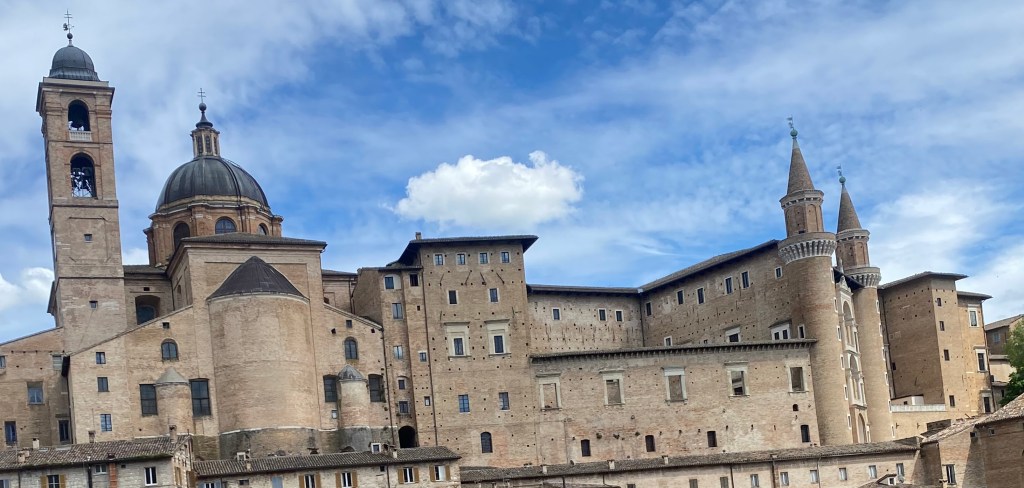
I found a book titled “The Light of Italy” in a bookrack facing the very piazza where that “Light,” Duke Federico da Montefeltro, had grandly expanded his Palazzo. This was at the height of Montefeltro’s rule before he died in 1482. Browsing touristy kitsch within 100 yards of that palace, I bought this good paperback history, which is in English. I have been reading it.
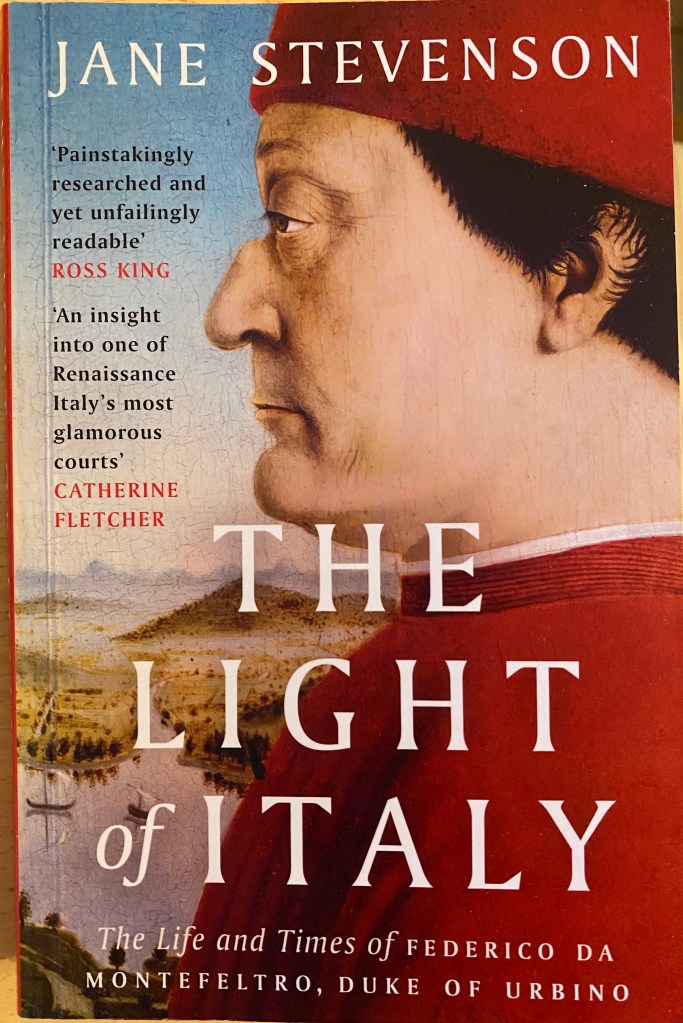
This passage seemed especially important, at the beginning of Chapter 8, “The Palace at Urbino”:
One of the Greek works that was rediscovered in the Renaissance was Aristotle’s Nicomachean Ethics, in which, among much else, the philosopher states: “The magnificent man is an artist in expenditure: he can discern what is suitable, and spend great sums with good taste.”
The wealth of Federico da Montefeltro was staggering, even by today’s standards. It was partly inherited and greatly expanded through shrewd marriages and his success as a warrior in great Italian battles. He once visited Pope Sixtus IV accompanied by 2000 of his knights, according to this book by Jane Stevenson. He brought great artists and philosophers to his Urbino palace, and kept a vast classical library there – and a giraffe.
It is a common understanding of the Middle Ages and Renaissance in Europe that “rediscovered” classics, especially by the Greek philosopher Aristotle, were like the discovery of electricity, oil and nuclear power in one Eureka!
Aristotle was practically equal to the Bible for explaining and directing human life. “Ipse dixit” was the authority the Middle Ages gave him, Latin for “He said it.”
I wondered if the “redefinition of magnificence,” as Stevenson put it, was also a description of one of Aristotle’s long-forgotten “virtues” – liberality.
“Liberality” is the virtue of generosity in a political and civic context. It was one of the classical virtues that challenged Thomas Aquinas – the great 13th century synthesizer of Aristotle and Christianity. Aquinas, in his authoritative “Summa Theologica,” worried that giving away too much personal wealth (as Jesus called on the rich man to do) could mean neglecting one’s home and family. (Machiavelli worried about a Prince’s generosity too, but for different reasons.) Furthermore, Aquinas noted, a poor man lacks the means to practice liberality, if it is truly a universal virtue.
Aquinas solved these problems, as super-intellectuals can do with their logic, by saying that “liberality” as a virtue is practiced in balance and over time – not prodigally – and that a poor Christian practices it in proportion to his poverty. Yes, he concluded, liberality IS a Christian virtue. Ipse dixit.
I am thinking about “liberality” as a good ethical practice because – as an exercise in the virtues, my journalism was one of those old practices. It was, I hope, in service to the common good.
The Lost History of Liberalism, whose author Helena Rosenblatt was featured in a recent Ezra Klein podcast, argues that political liberalism has been at the heart of Western thought for at least 2000 years, at least as far back as Cicero.
It seems to be close to what Aristotle described three centuries earlier in his Ethics, as “magnificence” – generosity for the public good.
Rosenblatt, as I understood from her interview, found countless references to “liberality” as the moral virtue of Western politics. For centuries, it was the virtue of a white male elite, as democracy itself was, even with our Founding Fathers 250 years ago.
When “liberalism” began to be more universal, it retained an expectation of generosity for the public good. “Liberal” in the 18th and 19th centuries was applied to free market capitalism and utilitarian ethics, but its advocates were moralists, fundamentally. They believed in the “liberal” that is meant when we go to college for “liberal arts.” The freedom of citizenship and leadership, of libertas, is necessarily a balance of rights and responsibilities. Freedom of conscience has its public obligations.
Rosenblatt’s book is good news for liberals today.
But there’s a problem, according a commentary by “pro-liberal” blogger Matthew Steiner, of liberal-arts Dartmouth College and Harvard Law School. During the Cold War, the great moral tradition of liberalism took on a dried-up moral neutrality – freedom, but for what? Liberalism became morally relativistic after World War II, he says. Afraid of their deeper “liberalism,” journalists adopted the pseudo-science of “objectivity.”
Going back to the Aristotelian idea of “the virtues,” liberality needs to be a practice, not just a political opinion. It is about character formation, about how we teach the next generation in public schools, about the content of civic institutions.
I am a liberal, okay? I am shaken by what is obviously illiberal about the Trump Administration and the craven Republicans in Congress who allow it.
The liberal media? From my perspective, journalism, like a liberal arts education, should be “liberal” in the broadest sense. Both are rooted in the ancient meaning of “liberality” that gave us the Declaration of Independence and, in an earlier form, gave us the magnificence of the Renaissance.
I think it is a stroke of genius that the city of Urbino has created an Urbino Award to give to a top American journalist each year, presenting it in a colorful Italian ceremony in Montefeltro’s Grand Hall.


Leave a Reply