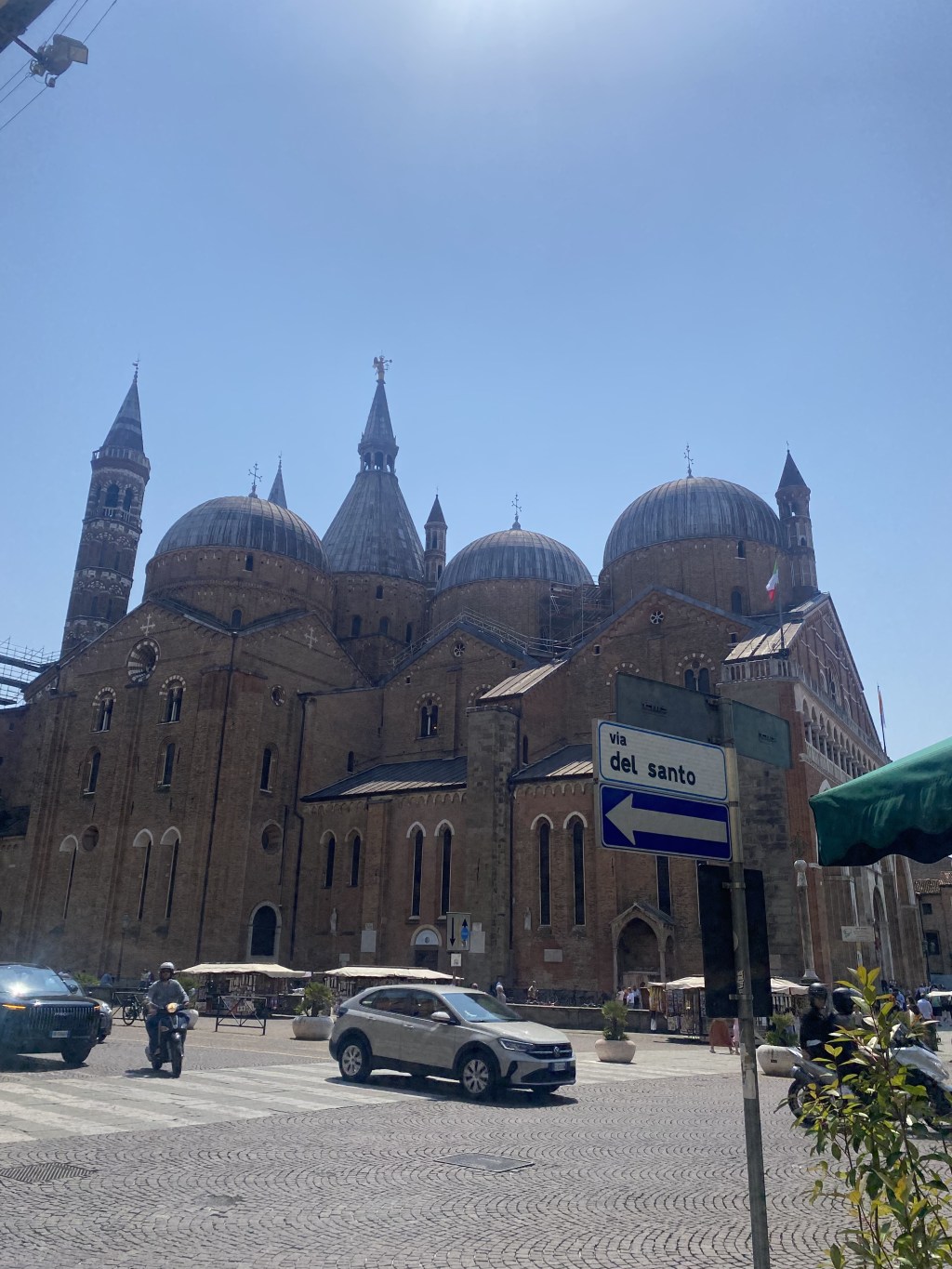
The gigantic church of Saint Anthony of Padua, the “Basilica del Santo” in the city of Padova, can intoxicate an Episcopalian from the Protestant U.S. South.
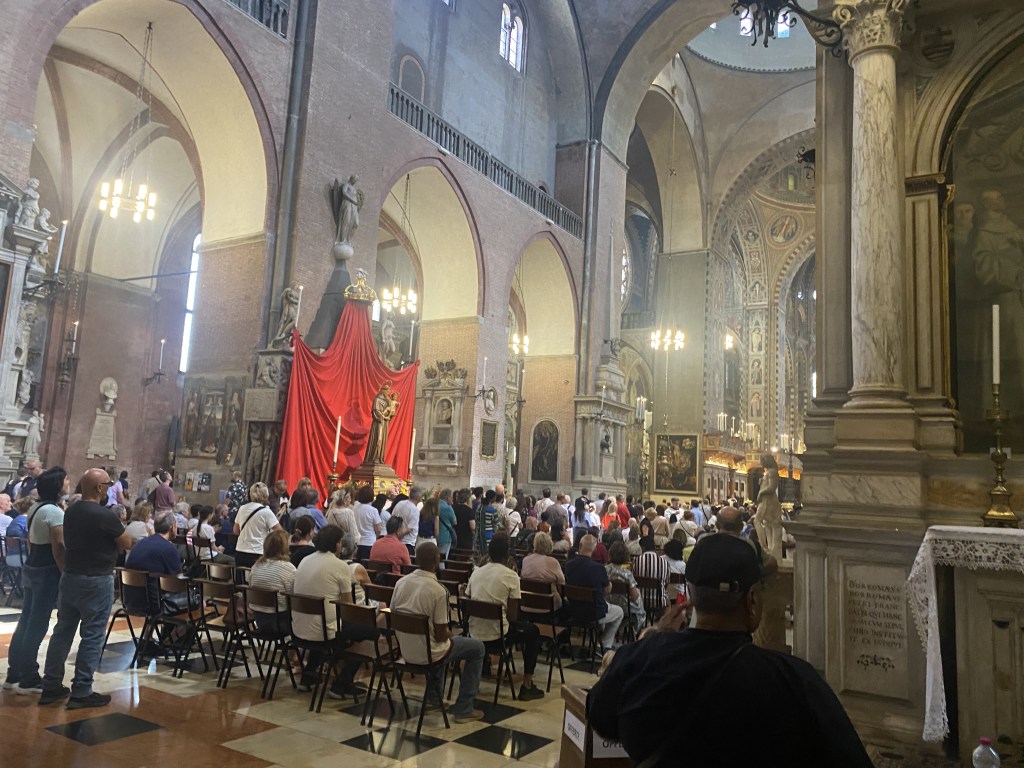
Its multiple domes and bell tower loom humongous over its piazza. You barely notice the attached structures, a museum, abbey, ancient library and a Cloister of the Magnolia (biggest magnolia this Southern boy has ever seen). Walk inside, during a crowded Mass or later when hundreds of devotees circulate and pray, and you may be strangely moved.
The basilica is an overwhelming expression of everything medieval – so much so that it’s hard to attach a word to its architectural style. Two chapels inside are included in a designated UNESCO World Heritage Site. The lush interior is a mix of Byzantine, Romanesque and Gothic, with a nod to St. Mark’s in Venice. Construction of the church was started in Anthony’s memory almost immediately after Anthony’s death in 1231. He was sainted even more rapidly.
Who was this St. Anthony of Padua?
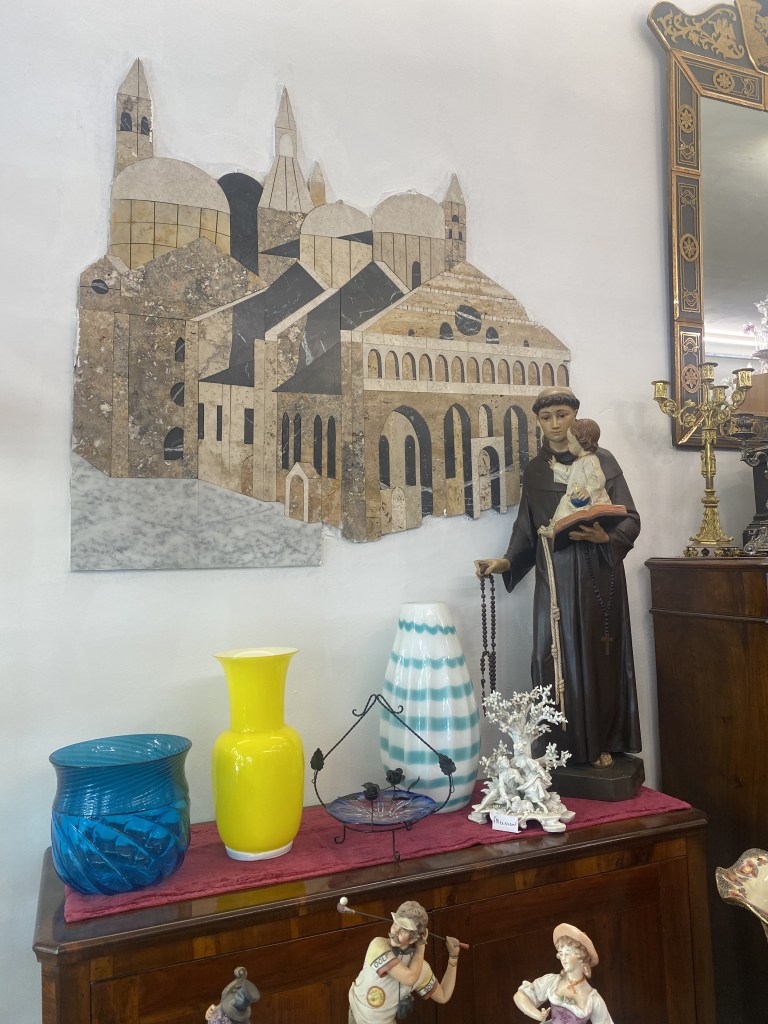
I have. . .connections. He’s the namesake of San Antonio, Texas, where in-laws and a cousin live. He’s also the namesake of the Catholic school in Tigard, Oregon, where my niece’s husband is the principal.
This principal, Dr. Gary Beckley, gave us a tour of the school last September and pointed out a picture of St. Anthony of Padua. He said he was the saint of lost things and lost people. I could relate.
The living Anthony died in Padua, but his remarkable life was mostly elsewhere. Born in Portugal in 1195 of a noble family there, he joined a religious order, took the name of the Desert Father Anthony, suffered illness doing missionary work in Morocco, was storm-tossed to Sicily and ended up in Bologna and Rimini, and finally, in Padua. He died near there of ergotism, a wretched disease from the rye-based fungus ergot that also causes hallucinations.
His gifts were prodigious. He was so scholarly (as a professor-preacher) that his contemporary, Francis of Assisi, named him as the singular theologian capable of maintaining Franciscan holiness as a bookish monk. His preaching of the “grandeur” of the Catholic faith was so crystal clear it instantly educated the illiterate and is said to have drawn fish when he preached alone on a riverbank. He was especially fervent in serving the poor and the sick.
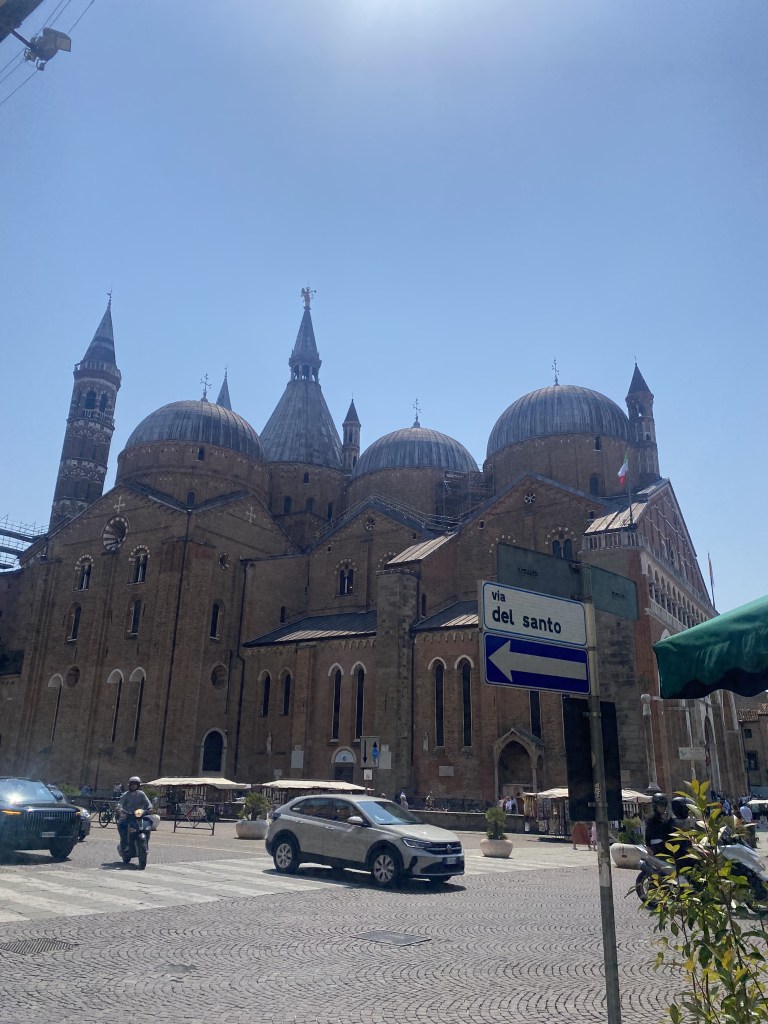
His help in finding lost things may have helped Libby when she realized, leaving the Basilica, that she had lost the 35-euro ticket that was to give us three days of going to Padua sites for free. Hundreds of people were passing out, and in, of the entrance. I thought it would be hopeless for her to go back in to look for the ticket.
But she went back to one of the pews where she had sat, and found her ticket. A monk sitting behind that pew looked at her and smiled.
We all lose things. More importantly, I think, for those who come here to pray and touch the stone marked as Anthony’s grave, we lose people we loved. On both sides of that grave, hundreds of color snapshots of people, mostly children, were crowded together. I assumed these were the lost and departed.
We all know how it feels to lose a key —
The grope through pockets, scouring memory.
I wrote those lines after entering the tidy home of our daughter Sarah for the first time shortly after her death in 2023. The loss was hard to bear. It was like losing a key to everything.
Will we ever drive again, get home,
Open that box that holds jewelry and comb?
The lines became a poem. . .
The last key lets me in the house she left.
I feel her essence here, stand still, bereft.
Books and boxes, cedar and cigar
Fragrances and words that were, that are. . .
Pray for us, Saint Anthony.
Across the piazza where we ate lunch, I noticed a “piazzetta” sign with another familiar name: Padre Massimiliano Kolbe. Maximilian Kolbe was a Polish monk who was arrested by the Nazis in 1939 when the Gestapo shut down his monastery. He was sent to Auschwitz, where he was starved then fatally injected with carbolic acid.
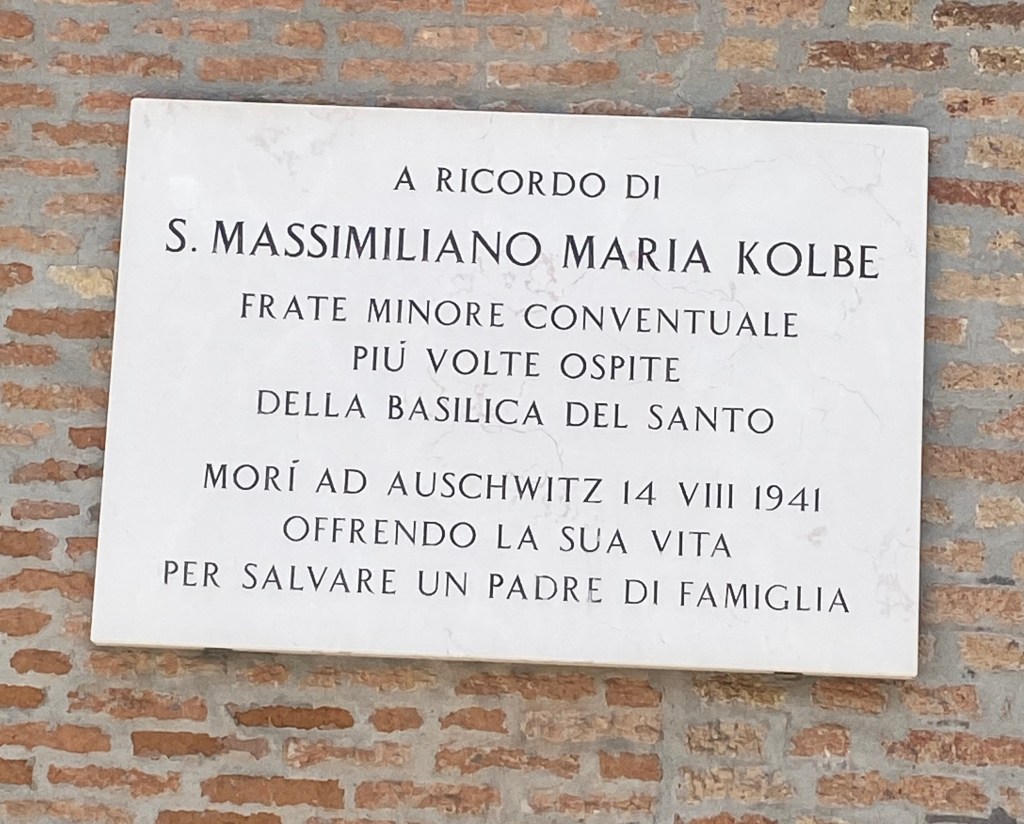
Wikipedia describes his martyrdom this way: At the end of July 1941, a prisoner successfully escaped from Auschwitz. In reprisal, the deputy camp commander, SS–Hauptsturmführer Karl Fritzsch, ordered guards to pick ten men to be starved to death in an underground bunker. When selected, Franciszek Gajowniczek, a Polish Catholic, cried out, “My wife! My children!” At that moment, Kolbe volunteered to take his place.
Gary Beckley also told me about Saint Kolbe (Pope John Paul II canonized him in 1982.) Kolbe was the namesake of a former Catholic school where Gary taught, and he and my niece Anna named one of their four daughters Kolbie in his honor.
It is good to keep the memory alive of those who show courage and serve humanity, in any century.


Leave a Reply