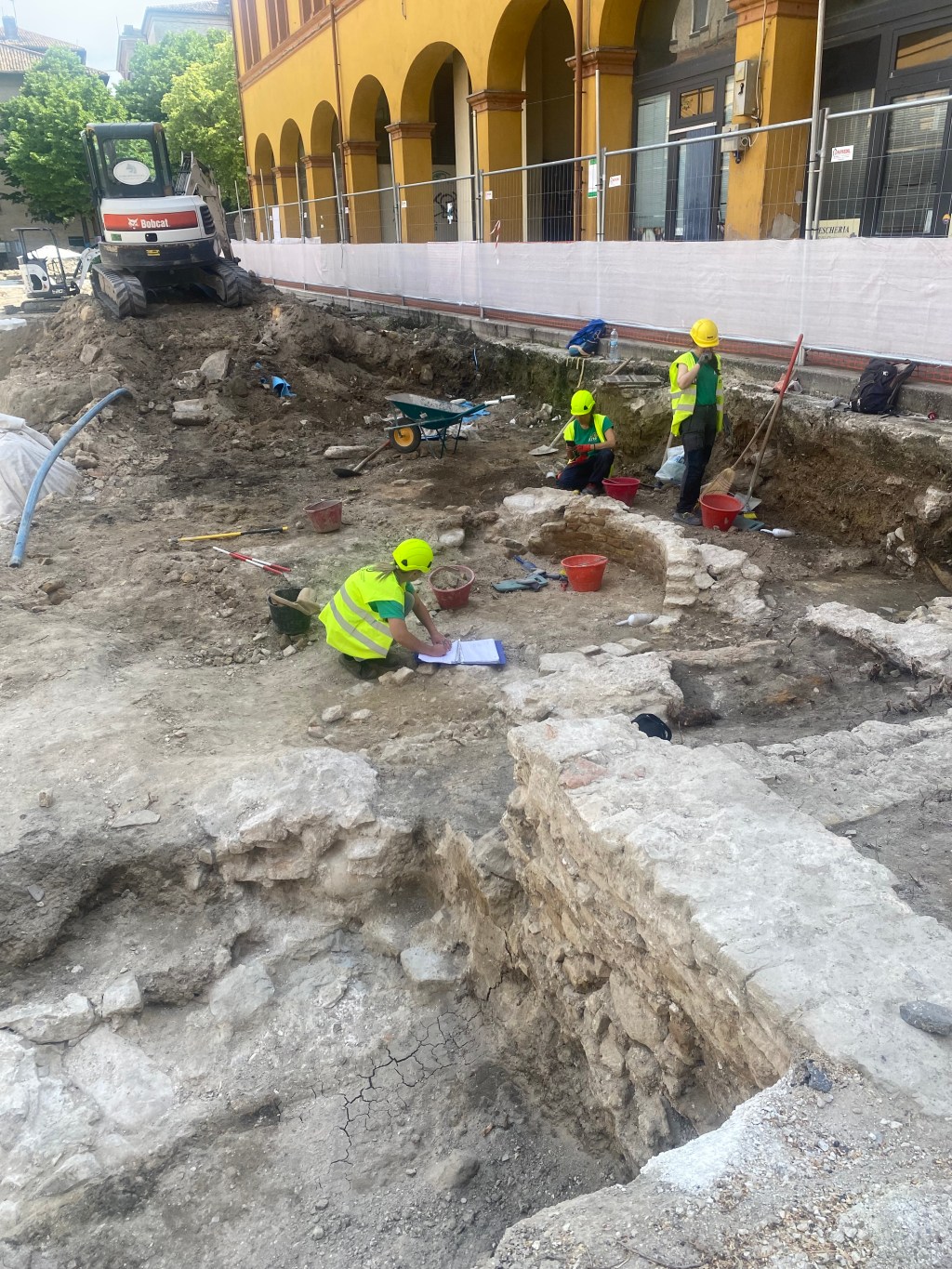
Three young women wearing bright yellow work vests and matching hard hats are committing archeology in one of Italy’s most exciting new digs this year.
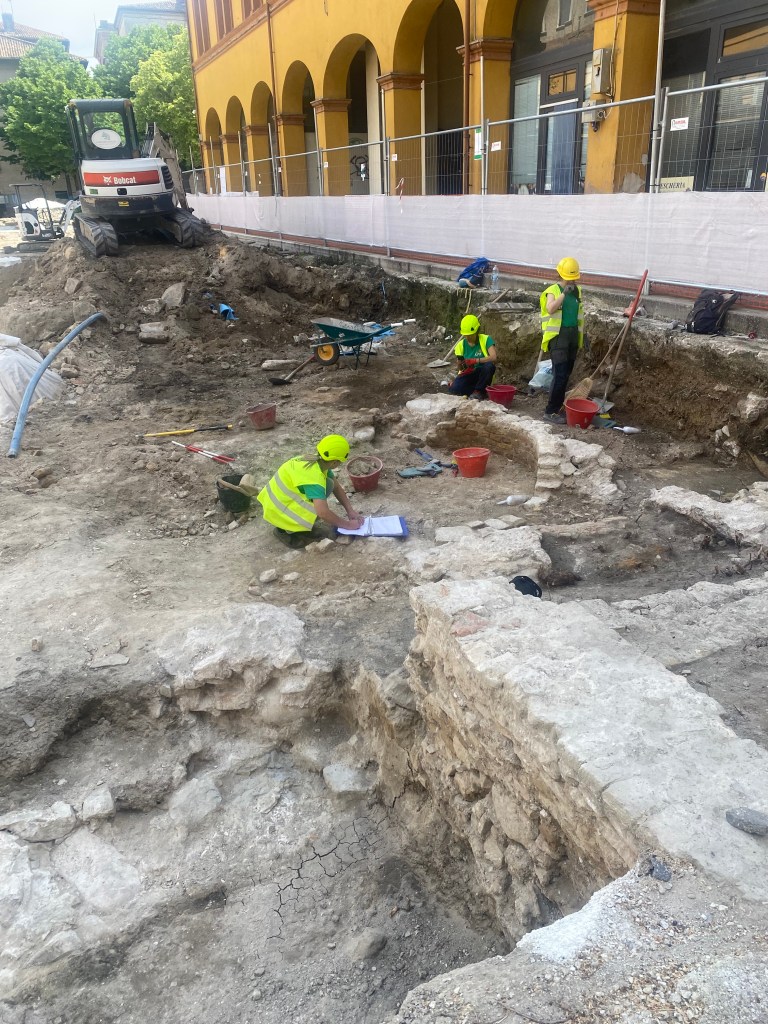
One is brushing dirt with a what looks like a paint brush. Another checks a loose leaf notebook with drawings and text, then chases a few loose pages that escape in a breeze.
A third is watching a grunting Bobcat tractor tear at the stubborn roots of a tree stump with its shovel-claw.
The Bobcat jumps and tips on uneven dirt as the man in the cab pushes hard. The tree roots seem to be winning. But an hour later, the stump is gone, leaving a hole like a deep-rooted molar removal.
Passersby and group tours on the cobblestone Via Arco d’Augusto stop in clusters to watch.
I walk past this block-long archeological site daily, where progress is rapid on the 2000-year-old foundation of the long-lost basilica by the famous Roman architectural theorist, Vitruvius.
I think of the contrast with the giant gap that has been left with the demolition of the East Wing of the White House. I’ve never been inside the White House. But I’ve seen it from all sides in its neo-classical (and surprisingly small) dignity. They call it the People’s House.
But President Trump considers it His House, decorating the halls and offices with faux Rococo gold and portraits of Himself.
Last October in Washington D.C. (at the same time a routine check for archeological significance began at this site in Fano), bulldozers abruptly leveled the East Wing to make room for the giant ballroom Trump wants to attach to the White House. He said it would be paid for by himself and private donors. This week, Republicans in Congress have put $1 billion into their proposed budget for the Mar-a-Lago-style ballroom.
The politics of Trump’s ballroom, thumbing its nose at the usual oversight and critical evaluation by architectural historians, is just another bitter division of the American people.
In Fano, the Vitruvius discovery seems to be uniting and exciting the city.
Last week, the Fano City Council, which is usually divided by a typical Italian “opposition” minority, voted unanimously on a motion to seek designation as “City of Vitruvius, a UNESCO World Heritage Site.” The council’s motion goes into detail about its future plans to make the most of this “discovery of a century.” This is on top of its proposal to join with neighboring Pesaro and Urbino to be declared “The European Capital of Culture 2033.”
I’m reminded of Atlanta’s cocky ambition to become the site of the summer Olympics of 1996. It too was a grand vision, and it won.
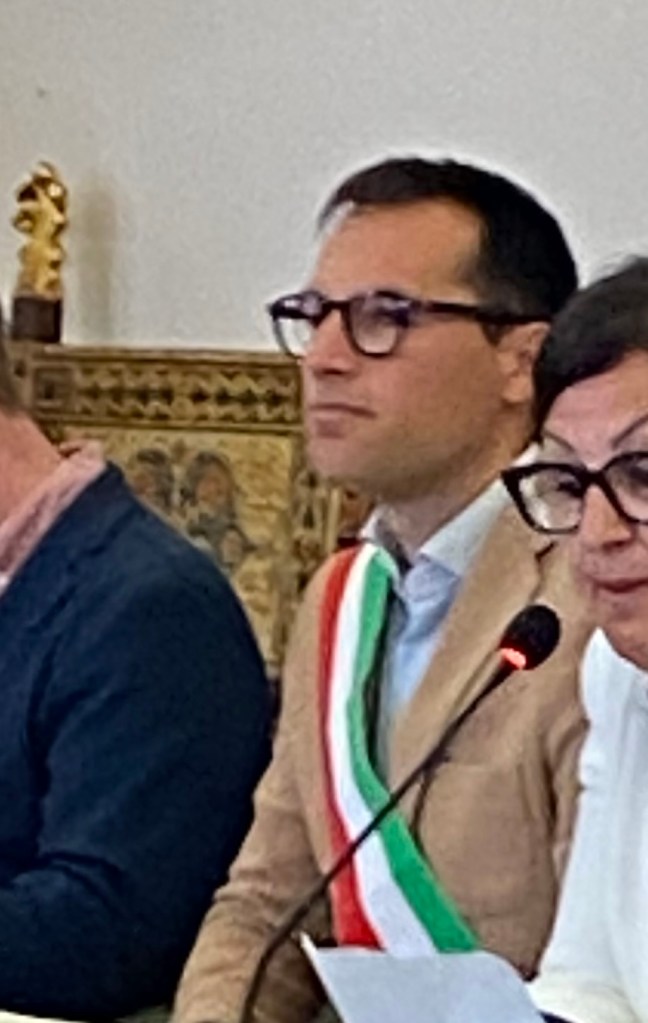
Fano’s Mayor Luca Serfilippi, who makes dapper public appearances in white running shoes and wearing a diagonal sash with colors of the Italian flag, was ebullient in calling this a turning point for Fano. “Fano has chosen to transform its history into a vision for the future,” he said.
Quoted in the local edition of the national daily Il Resto di Carlino (in Italian, of course), he went on:
“The first signs are already evident: guided tours are increasing, and interest in what is emerging is growing. Vitruvius can become the cornerstone around which to build a new vision of the city, capable of uniting culture, development, and identity.”
To a skeptical American journalist, this can sound like the usual local boosterism.
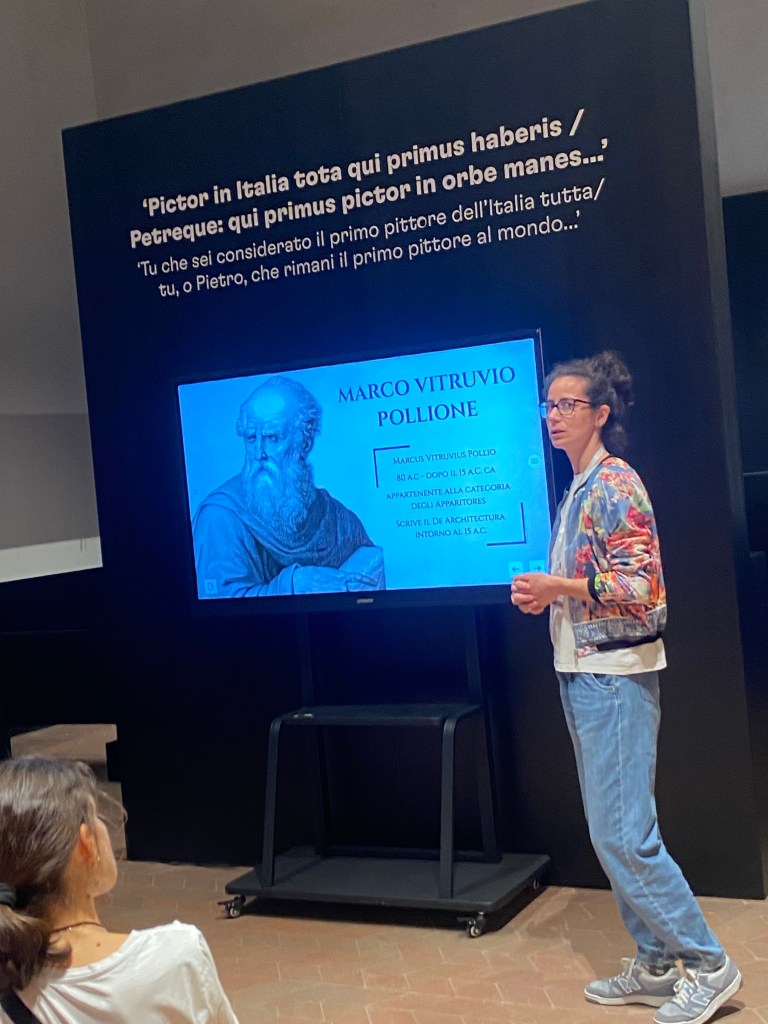
But the competence and plans seem very real. “We need method, vision, and time, but the process must be started immediately, seriously and without shortcuts,” the mayor said. “We can’t just safeguard an artifact: we need to build a strategy. We need a stable control room to coordinate the excavations, promote them, and communicate them nationally and internationally.”
The quotes continue: “The motion places an even greater responsibility on us, shared with the entire municipal council and the city council. I appreciated the opposition’s sense of responsibility.”
The work at the excavation site has moved rapidly since it began on April 15. At a news conference on Wednesday, a city councilor said that Italy’s Ministry of Culture has recognize the $2.1 million that Fano has spent on the excavation and has initially contributed $412,000 to that.
On-site archeologists have already found several “yellowish” marble slabs of what they think was the original flooring. They also found the remains of a woman who died in childbirth during the Renaissance, with her baby’s skull still resting on the pelvis. And they found some remains of former modern commercial businesses. It’s a layer cake, but the Vitruvius foundation is only a little over two feet deep.
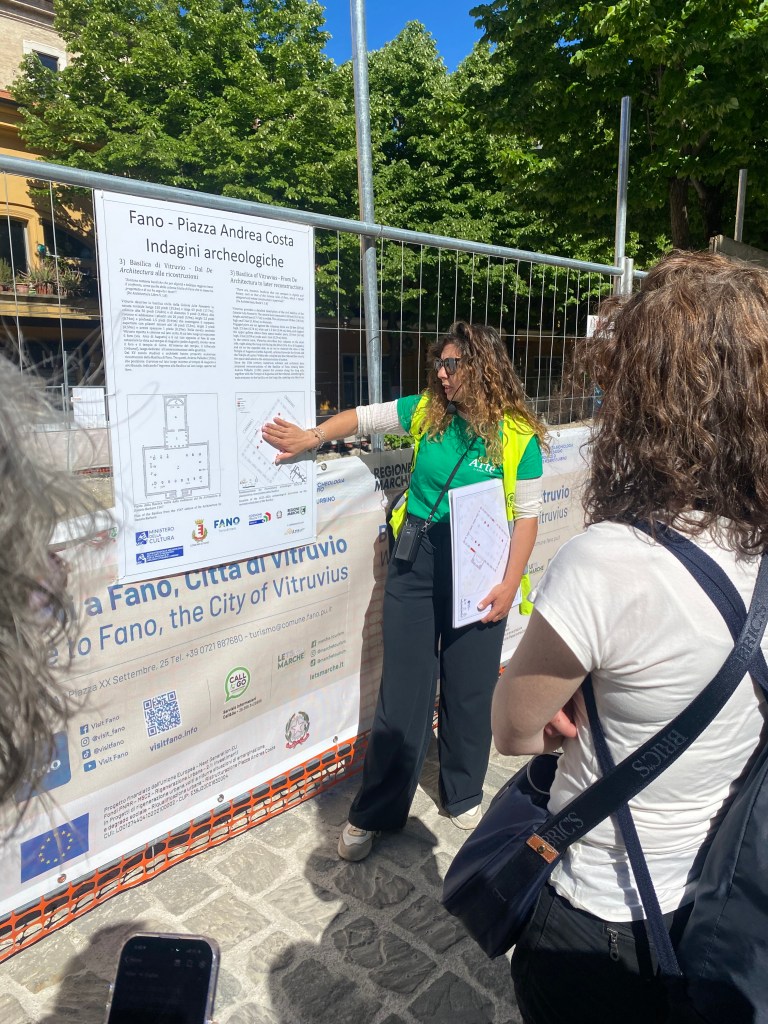
Project Superintendent Andrea Pessina announced that archeologists would begin providing free hour-long tours of the site every Wednesday, market day, from 11:30 a.m. Also, the press will be given briefings on new discoveries and updates every two weeks.
“We are living in a very important and delicate moment in history,” Mayor Serfilippi said at Wednesday’s press briefing.
This is true in the United States too. Important and delicate! But there, the architecture and memorializing of a President who acts like Augustus Caesar is bringing not “one nation, under God,” and certainly not a reverence for the past or vision of the future.
The bulldozers there, back in my dear country, seem to be ripping it apart.


Leave a Reply